Government-issued photo ID and signature verification should be required at the time of voting.
Claim 04-003-002 · Q3 | Impact

Meaning ┃ Evidence ┃ Impact ┃Solution
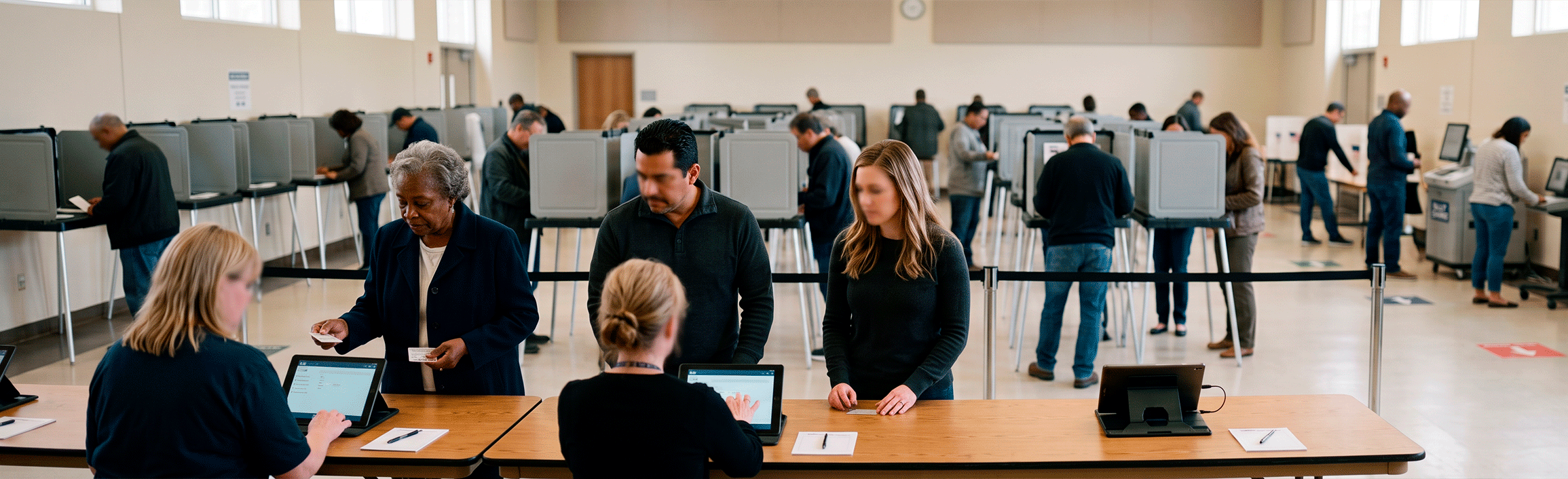
Who And What Does This Claim Impact?
Evidence is noted in [ ]
I. Introduction
Q1 | Meaning explained what this claim means. Q2 | Evidence listed the facts. Below we explore what happens if the claim becomes law - who and what are affected, and how much. Our proposed solution is provided in Q4 | Solution.
We run every claim through four tests to consider its impact:
Who and What are affected?
How Big is it, based on the evidence?
Options: What can be done to limit the negatives and increase the positives?
Projections: What happens over time?
NOTE: Evidence is referenced in [] - e.g., Evidence A-8 is listed as [A-8] and can be found on the Evidence page.
We trust evidence in this order:
Laws and court records
Official records and audits
Peer-reviewed studies
Surveys – estimates, not counts (see “Is That a Fact?”)
Claims from advocacy groups
II. Solution Dependencies: What This Claim Needs to Work
This claim checks a voter’s identity at the moment of voting. There are other claims to update our laws for full election integrity to be achieved. Three closely relate to this claim of requiring government-issued photo ID and signature verification when voting:
Accurate voter rolls must be maintained. About one in eight voter registrations is wrong. Often it is simply outdated or a duplicate [A-8], but it can also be an ineligible voter. And the system of confirming citizenship and voting rights at state DMV or other registrars is flawed - it can be subject to bribes and other corruption, resulting in registering aliens as American citizens. The process of registering citizens and voters must be improved to maintain public safety and trust in our election process. This claim will be researched by our team and added to the topic of Election Integrity.
All voters should be required to re-register to vote. There is clear evidence that the use of fake IDs and AI to commit fraud is increasing, and there is voting by non-citizens. To restore faith in our election process - that only qualified citizens are voting - all voters should be required to re-register. This claim will be researched by our team and added to the topic of Election Integrity.
At all times, citizens must have a real, current, government-issued photo ID. Millions of adults may lack one, based on survey estimates.[D-3] Meanwhile, fake IDs have become cheap[A-13] and AI is making identity fraud easier.[A-14]. This is primarily a national security and citizenship issue - and is not driven to increase government’s ability for citizen surveillance. This claim will be researched by our team and added to the topic of Citizenship.
How they combine for the common good:
The process of confirming citizenship and voter registration is flawed. As digital and AI fraud grows, it must be strengthened while reasonably achieving a balance of accuracy, efficiency, and simplicity.
Re-registering with a current ID clears out the fraud and renews integrity to our voter data.
Maintaining a current ID is logical, reasonable, and important for public safety. It is also consistent with laws to show current ID when purchasing liquor, flying on commercial airlines, getting a driver’s license, and other activities.
These pending claims address real needs and have the potential to significantly simplify and increase trust in our election process. We will give each its own full review.
III. Testing Each Sub-Claim
SC-1 | Preventable fraud occurs, is likely undercounted, and could affect the outcome of a close election.
Fraud is real:
More than 1,400 cases ended in convictions or other official findings.[A-1]
One congressional election was thrown out over an absentee-ballot scheme.[A-3]
A man forged his dead wife’s signature on a mail-ballot request – the signature check caught him.[A-4]
A voter allowed to vote without ID turned out to be fraudulently registered.[A-5]
1982 Chicago: An estimated 100,000 fraudulent ballots; 63 people convicted.[A-7]
But it is rare:
The same database holds only about 10 cases of someone pretending to be another voter at the polls - out of billions of votes.[D-1]
It holds 41 noncitizen voting cases over about 50 years.[D-2]
Georgia’s audit: 20 noncitizen registrations, 9 votes, out of 8.2 million voters.[N-20] Utah: 1 and 0, out of 2 million.[N-21] Ohio: 521 flagged, 1 charged.[N-23]
What we found. Fraud is real - it has even flipped an election.[A-3] Some surely goes uncaught; the database’s own authors say they only count what was caught.[A-2] But when states searched hard, they found very little.[N-20, N-21, N-23]
Conclusion: Election fraud is rare, but in a close election, even a little can decide it. The Supreme Court said the same.[A-6]
SC-2 | Current safeguards are insufficient, and digital technologies including AI are making them more so.
The rules are uneven:
36 states ask for some ID; 14 ask for none.[N-1]
32 states check mail-ballot signatures; 10 plus DC only check that the envelope was signed.[N-2, N-3]
No-ID states rely on a signature and the voter stating their name and address.[N-4] Federal law covers only certain first-time voters.[N-9]
Registration runs on the honor system – you swear you are a citizen, and that is it.[A-9] The rolls have many errors.[A-8]
And the safeguards are getting weaker:
$15 fake IDs fooled a company’s automated ID check.[A-13]
The government warns that AI-made fake documents are fooling banks.[A-14]
What we found. Two problems: (1) The safeguards are uneven, and they are getting weaker as technology improves; and (2) Whatever the fraud rate is today, cheating is getting easier and cheaper.
SC-3 | Requiring photo ID and signature verification will reduce ineligible voting.
What supports it:
Signature checking caught a forged mail ballot before it counted – the clearest proof that verification works.[A-4]
A bipartisan commission led by Jimmy Carter and James Baker recommended photo ID paired with free IDs.[A-11]
The systems needed to check voters already exist and run every election.[N-2, N-5, N-25]
The hard part:
The biggest national study found strict ID laws had no measurable effect on turnout - and no measurable effect on fraud either.[A-15]
What we found. The measured proof that this law would reduce illegal voting may be modest, but no state currently requires both government-issued photo ID and signature verification - so no data exists. Also, we did not investigate the depth and reliability of signature verification systems. These systems may or may not need improvement.
The strongest proven tool is the signature check on mail ballots.[A-4, N-2] This sub-claim leans mostly on SC-1 (rare fraud can flip close races) and SC-2 (cheating is getting easier) - on prevention and public trust - more than on measured results. Our Q4 | Solution must weigh that.
SC-4 | Eligible voters would not be wrongly blocked.
Who could be blocked:
A survey estimates over 49 million adults lack a current, unexpired license with their current name and address[D-3] (survey estimate, n=2,386, weighted).
A court counted 608,470 registered Texas voters – 4.5% – without qualifying ID under one strict law.[D-6]
Those without ID are more often elderly, low-income, minority, or student voters.[D-4, D-5, D-10–D-12]
North Dakota’s street-address rule shut out tribal IDs that list PO boxes.[D-13]
Some studies found turnout dropped 2–3 points after strict laws.[D-7, D-8] In North Carolina, voters without ID kept staying home even after the law was struck down – because nobody told them it was gone.[D-9]
Signatures change with age and illnesses like Parkinson’s – risking rejected ballots.[D-16]
On the other side:
The biggest national study found no turnout drop at all, for any racial group.[A-15]
The Supreme Court ruled Indiana’s law was not a heavy burden for most voters.[A-10]
Options:
Free IDs are now standard – courts push states to provide them. Indiana’s law survived because IDs were free;[A-10] Georgia’s survived only after a court called its fee an illegal poll tax.[D-14]
The Carter-Baker plan added outreach and mobile issuance for those who need help.[A-11]
Fix-it (“cure”) windows are written into the law,[N-7, N-8] and officials compare several signatures on file.[N-6, N-25]
Design rule learned the hard way: Accept tribal IDs as issued.[D-13]
If Companion Claim #3 passes, nearly everyone will already have an ID (Section II).
Projections - what is left:
The hidden costs a free ID does not fix - getting a birth certificate, travel, and time off work. That is what the poll-tax ruling was really about.[D-14]
Voters whose signatures have changed are only as protected as the fix-it process is good.[D-16, N-6]
Confusion. North Carolina proved a law can keep scaring voters away even after it is gone, if nobody tells them.[D-9] Clear communication changes the outcome.
What we found. There is a burden, but it is limited and can be overcome by targeted support for those with real need. For example, states can provide free IDs, fix-it steps, fair rules, and our Companion Claims help level the playing field.
It is illogical and unrealistic to claim 100% of eligible citizens will ever register to vote and vote in every election. Our Q4 | Solution focuses on what’s best for the common good.
SC-5 | The cost and effort are justified.
Public support is strong and repeated:
84% support photo ID (Gallup).[N-11] 83% (Pew).[N-12] 77% called it “reasonable” - the actual word in Rasmussen’s question.[N-13]
Three polling companies, different methods, same answer, within months.
Voters in 15 states approved citizenship-voting measures, averaging 73% yes.[N-17]
The cost side:
One court struck down an ID fee as an illegal poll tax - so the ID must be free.[D-14] Only a small share of voters - roughly five percent or less - would ever need one provided.[D-3, D-6]
State records put implementation costs in the single-digit to low-double-digit millions per state.[N-28, N-29] Most figures are from 2005-2011, so modern cost data is thin (see Section VII).
Studies find no consistent link between strict ID laws and higher voter confidence.[D-18]
What we found. The public strongly believes this is reasonable. Other states’ records now give us a price range, though the figures are dated.[N-28, N-29] “Worth it” is a Q4 | Solution decision. Q3 | Impact’s finding: The support is solid; the cost is bounded but dated.
SC-6 | The requirement can be implemented fairly and uniformly.
It can be done fairly:
The Constitution gives this job to state legislatures and Congress.[N-10]
Indiana is the tested model: Photo ID, free IDs, a 10-day fix-it window - upheld by the Supreme Court.[N-7, N-8]
Even the leading opposition group supports “commonsense” ID rules, pointing to Rhode Island and Michigan as fair ones.[A-12]
The limits:
36 different state systems today.[N-1]
Courts blocked the president’s attempt to change election rules alone,[N-19] and a promised national voter-ID order has been announced twice and never issued.[N-24]
A state court struck down New York City’s local overreach in the other direction.[N-16]
North Dakota shows how one small design choice can unfairly shut people out.[D-13]
What we found. Fair versions already exist - Indiana, Rhode Island, and Michigan prove it.[N-7, N-8, A-12] Making it the same everywhere is the hard part, and there are only two legal paths: State by state, or Congress. Not the president.[N-10, N-19, N-24]
Fairness requires an efficient system with boundaries - the system supports those who truly need it, not the irresponsible. Systems have succeeded when free IDs, fix-it steps, and reasonable inclusive rules were built in, and failed where they were not.[D-13, D-14]
IV. Common Scenarios
You forgot your ID. You vote a provisional ballot. It counts if you show your ID within the fix-it window - 10 days in Indiana.[N-7, N-8]
The cost to the voter: A second trip. Longer windows and remote fixes make it easier.[N-6]. Who’s fault? The voter.
The cost to the state: Minimal.
You do not have an ID at all. The ID itself can be free - courts push states to do that.[A-10, D-14, A-11] What is left: The citizen’s paperwork, the ride, and the time. If Companion Claim #3 passes, this problem goes away (Section II).
The cost to the voter: Completed in advance of registering to vote or as part of it. Support systems can eliminate the cost for the truly destitute.
The cost to the state: None - standard procedure.
You do not have a ride. Two different problems. (a) A ride to get and keep an ID - that is this law’s burden, and mobile ID vans can fix much of it.[A-11] (b) A ride to the polls on Election Day - that exists with or without this law, so it does not count against this claim.
The cost to the voter: States can eliminate this cost for those with a true need.
The cost to the state: Limited, but must have boundaries to avoid exploitation.
You vote by mail. How ID and signatures get checked for absentee ballots is handled in a separate claim: Fix the absentee voting process to deter and detect fraud (Claim # pending). This claim covers in-person voting. Today’s mail baseline: 32 states check signatures; 10 plus DC only check the envelope.[N-2, N-3] Mail rejection-rate disparities[D-15] move to that claim.
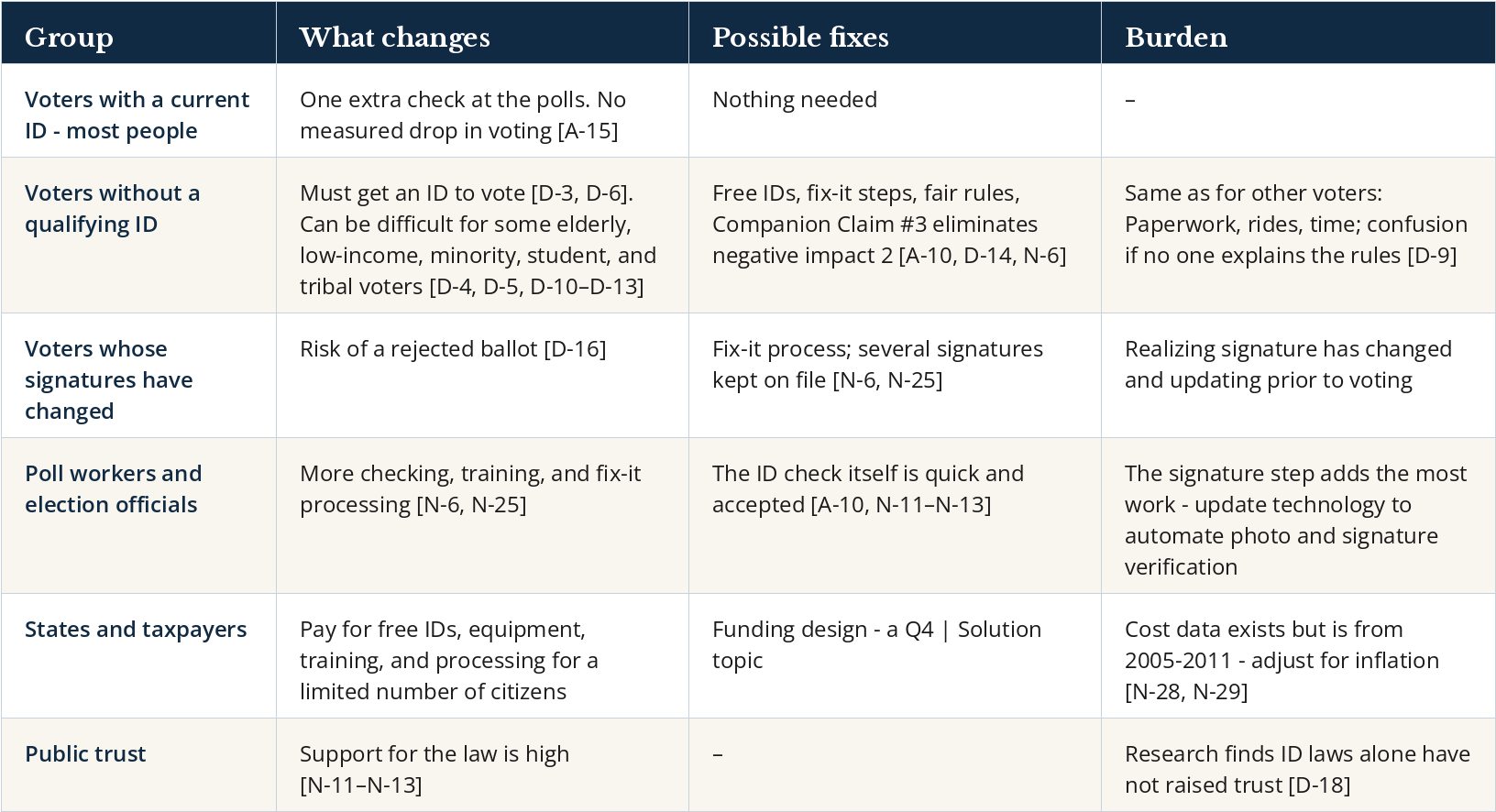
V. Who Feels This Law - Group by Group
VI. Leftover Evidence
Every evidence entry is accounted for. The ones not used above have new homes:
D-15 (mail-ballot rejection disparities) - moves to an absentee companion claim.
N-5 (states that require ID copies with mail ballots) – becomes Q4 | Solution design material.
N-14, N-15, N-16 (citizenship-voting rules) - stay as boundary markers in Q1 | Meaning Section XIII and seed Citizenship claims.
VII. What We Still Do Not Know
Answered by research since our first draft:
What these programs cost states to run - largely resolved by other states’ records.[N-28, N-29] Modern cost data is still thin.
Whether passing the law raises public trust - research finds it has not, by itself.[D-18] Our Q4 | Solution includes measuring it.
Still open:
No American election has ever tested the two checks together - photo ID plus signature.
Real counts of who has ID - every number we have is a survey estimate or one state’s court count.
How accurate signature checking is at the polls - today’s data on signature accuracy covers mail ballots only.
Whether these requirements scare off would-be cheaters before they try - the big study measured caught fraud, not prevented fraud.
VIII. Impact Summary
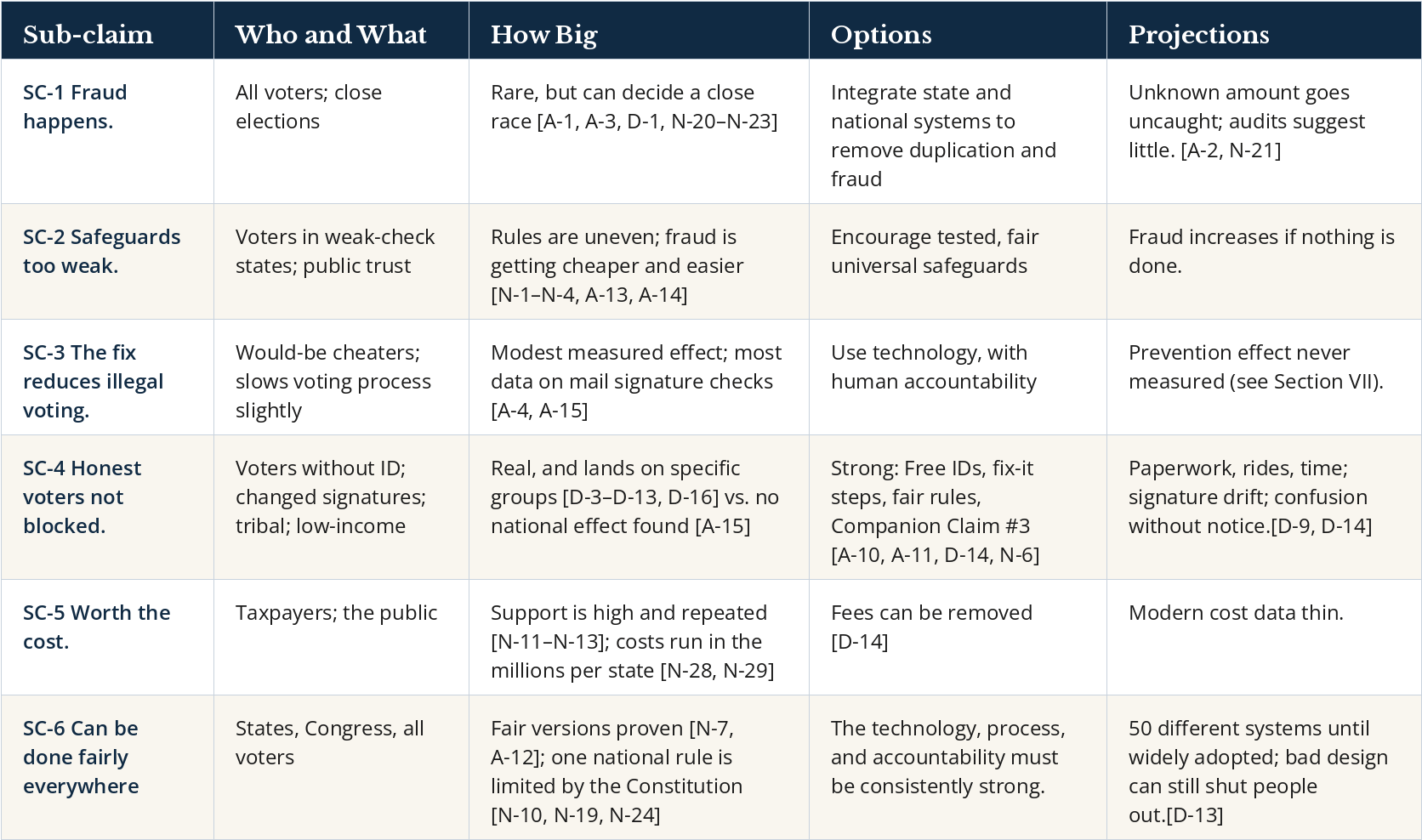
Voter fraud is real, and courts have proven it. Confirmed fraud is also rare - the actual total is unknown. The danger is that in a close election, even a small amount can change the result.
Meanwhile, the rules and processes for managing elections are different in every state, and technology is making it cheaper and easier to fake an identity every year.
The fix this claim proposes - photo ID plus signature verification - is one that large majorities of Americans in both parties call reasonable. No state requires both checks today, so its full effect has never been measured.
The burden on honest voters is real but limited, and can be managed: IDs can be free, mistakes can be fixed, and fair rules can be written - several states have already proven it.
What remains falls on a small share of voters - and for them, clear communication matters as much as the details of the law itself.
Two questions have now been researched: (1) Program costs - other states’ records put them in the single-digit to low-double-digit millions per state; and (2) Public trust - studies find that passing ID laws has not, by itself, raised it. Our Q4 | Solution builds on the first and answers the second with measurement.
The table below sums up the findings for each sub-claim.