

WHAT IF… We Required More of Congress?
What if all our elected officials were more committed to the common good of all American citizens instead of their own power and profit?


Let’s be honest about something most Americans already know, but rarely say out loud: Congress is broken. Not just a little broken.
It was brilliantly designed by our Founders, but is being manipulated for personal power, profit, and ruling class advantage — across both parties.
Our Founders built a government of public servants — people who serve the citizens. With excessive pay, lavish benefits, and a national debt that grows every single day, the equation has flipped.
Today, citizens increasingly serve the politicians and the government — the exact reverse of our founding design. Public servants today are a ruling class. We are the subjects.
Here is the truth that stings more: We allowed this corruption to occur on our watch. American citizens — you and me — have permitted elected officials to abuse their servant powers for personal gain.
We stopped holding them accountable.
We stopped investing our time to stay informed and engaged. We made excuses rather than being responsible citizens — we’re busy, or we choose to be entertained by sports, social media, or whatever. We got cynical, and fell for the lie that politics is someone else’s responsibility.
The good news? In America — for now — what citizens allowed, citizens can reverse.
That’s what Simple Liberty is — everyday commoners collaborating, across party lines, to develop real solutions to America’s biggest problems.
Not politicians. Not pundits. Us.
Ordinary citizens proposing solutions that serve the common good of all Americans — not one party, not the connected few.
INTERIOR IMAGE 1 of 4 — upload natively (3:2). Familia 2 / documentary community.
Let’s get to work. There are four cornerstone issues driving the dysfunction in Congress.
First, we need far more leaders with proven good character running for office.
Second, citizens need verifiable facts that are more easily accessible.
Third, citizens must commit themselves to finding the truth — not get fooled by entertainers, posers, and narcissists pitching distorted half-facts and outright lies dressed up as news.
Fourth, Congress must be forced to be good stewards and abide by the laws of the land — all of them. No more laws that exempt Congress. Enforcement of our laws should be modeled by Congress at its best, rather than exempting the political ruling class from consequences.
Here are seven “What If” questions about our elected officials in Congress. These are not radical demands. They are reasonable standards for people of good character — the kind of people our republic was designed to attract and depends on to survive.
Congress must be filled with people who believe in our republic. Good stewards committed to finding the best way in a civil manner, working together to do what is right, and demonstrating through their actions that all citizens matter equally.
#1 — WHAT IF… Character Actually Mattered?
What if we only elected members of Congress who were people of proven good character — totally committed to doing what is best for the long-term common good of all Americans, and who would not use their office for personal or family profit?
Imagine a Congress where every member divested completely from conflicting business interests before taking office. Where insider trading on legislation was not just technically illegal, but actively prosecuted. Where the phrase “public servant” meant something again.
This is not a revolutionary idea. It is the founding idea. The men who drafted our Constitution understood that self-governance requires self-governing people — leaders who place the common good above personal ambition.
We have had such leaders. Not perfect ones, but sincere ones — members of Congress who genuinely served their constituents, made hard votes that cost them politically, and returned home without having enriched themselves at the public’s expense. They exist today too, in both parties, though they are increasingly outnumbered and outmaneuvered by those who have mastered the art of self-preservation over service.
What if we made good character — real, regularly demonstrated, unwavering good character — our first and non-negotiable requirement for every congressional candidate? What if we simply refused to vote for anyone who had not demonstrated it?
ENDNOTES: 1–3
#2 — WHAT IF… We Eliminated Corruption in Congress?
What if we held every member of Congress to the same laws they pass for the rest of us?
This should be obvious. It is not. In recent decades, members of Congress have enjoyed privileges and protections unavailable to ordinary citizens — from insider trading advantages to legal insulation that would land a private citizen in prison.
Start with the basics.
What if any member convicted of a felony is immediately removed from office?
What if any member facing criminal charges is placed on unpaid leave while their governor appoints a temporary replacement — and citizens vote for a permanent replacement once the trial concludes? No exceptions based on seniority, party, or political connections.
What if elected officials and senior government employees must be audited annually? Not occasionally. Every year, without exception. Transparency is not a burden for honest people — it is only a burden for those with something to hide.
What if we removed every special perk that separates Congress from the citizens they represent? If a law applies to Americans, it applies to Congress. Healthcare, taxes, retirement, legal accountability — all of it. No carve-outs, no exemptions, no grandfather clauses.
We are not asking for saints. We are demanding servants.
ENDNOTES 4–6
#3 — WHAT IF… No Balanced Budget Meant No Pay?
What if members of Congress received no paycheck unless the budget was balanced — no debt created or committed?
Doesn’t that make sense? If they cannot properly manage our nation, then why are they paid?
In the fall of 2025, when Congress failed to do its most basic job — funding the government — the result was the longest shutdown in modern history at 43 days. The Congressional Budget Office estimated roughly 750,000 federal employees were furloughed each day, at a cost of about $400 million daily in withheld pay. Members of Congress, however, continued collecting their salaries. Senators earn $174,000 per year. The Speaker earns $223,500. Congressional salaries are protected by a permanent appropriation they passed in 1983, meaning it does not require annual renewal.
The Constitution guarantees congressional compensation. Fine. Nothing prevents Congress from passing a law that withholds their own pay during shutdowns and until a balanced budget is achieved. Several members have voluntarily refused their salaries during past shutdowns.
Let’s make it mandatory. No balanced budget, no paycheck. No funding agreement, no pay. When the consequences of congressional failure fall on federal workers and American families, the impact should first fall on Congress.
The president and vice president should also not be compensated for the time period when this occurs.
Lastly (for now), do not let them penalize citizens because they over-promise and over-spend. Tax increases are particularly painful for common citizens. It’s worth considering a requirement that any tax increase must require a two-thirds vote in both chambers. Raising the tax burden on American citizens is a serious act that should require serious, broad consensus — not a simple majority and a rushed vote.
Force politicians to work together.
Fiscal responsibility is not a partisan value — it is a stewardship obligation. Future generations are being handed massive, multi-trillion dollar debt they did not create and did not approve. That is not responsible governance. It is generational theft.
ENDNOTES 7–9
INTERIOR IMAGE 2 of 4 — upload natively (3:2). Familia 2 / documentary community.

#4 — WHAT IF… We Right-Sized and Refocused Congress?
What if we reshaped Congress — its size, terms, and schedule — into a body that was leaner, more focused, and far more accountable to the citizens it serves?
Start with size.
What if we reduced the House of Representatives to 250 members instead of its current 435?
The ruling class wannabes want to go in the opposite direction.
The House Expansion Commission Act (H.R. 2797) directs a commission to study the Cube Root Law, the Wyoming Rule, and other methods for enlarging the House. The cube-root method alone could push the House to roughly 700 members.
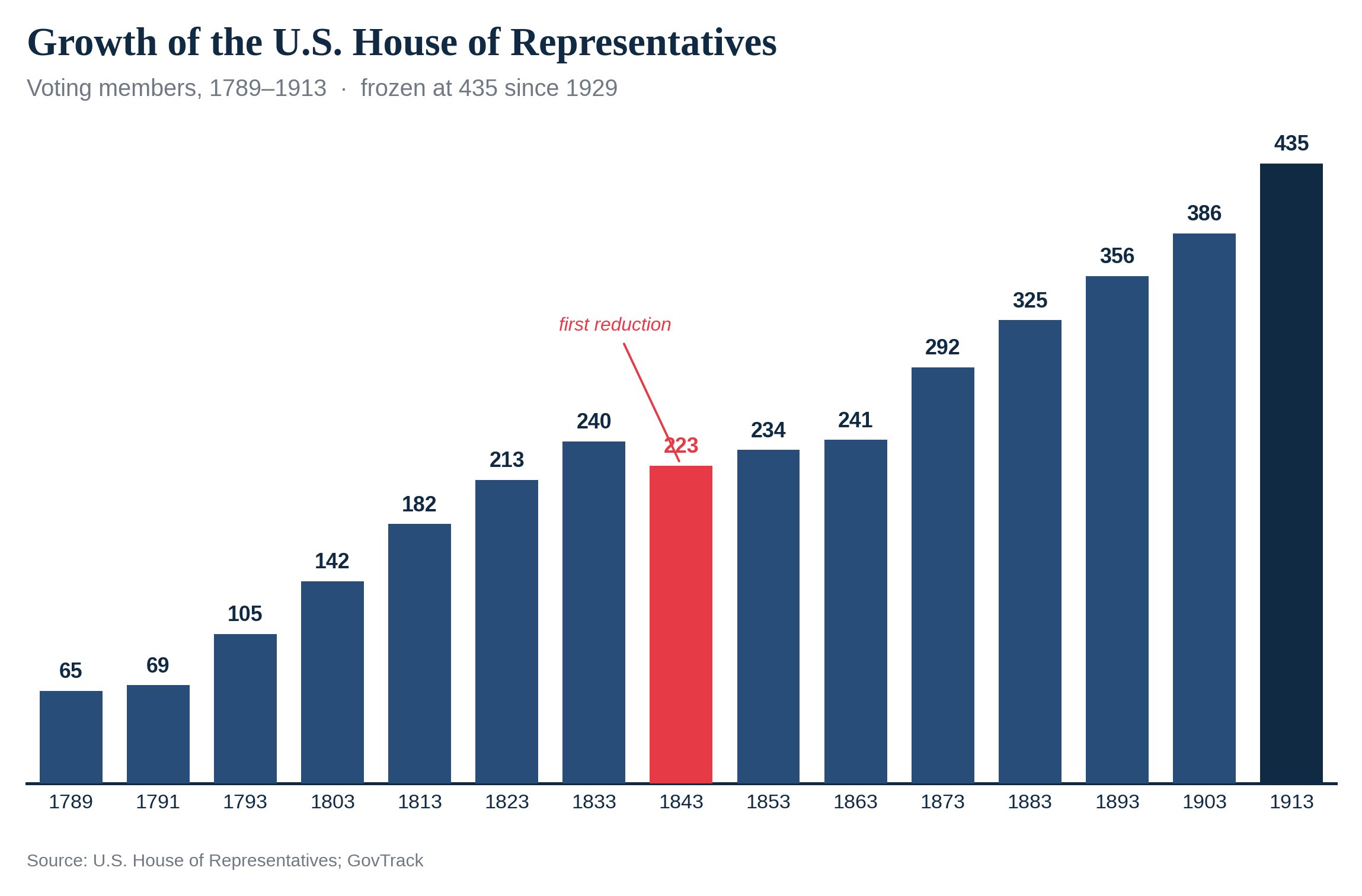
Proposals vary widely: A coalition convened by the American Academy of Arts and Sciences recommends an increase of 150 seats to 585, while grassroots movements such as Uncap the House push to repeal the cap entirely and expand the chamber significantly. Some commentators float ideas to expand the House to 1,000 or more.
All of it moves in one direction — more politicians and more potential for corruption, gridlock, and wasted taxpayer dollars to fund more politicians, their staffs, and the time they consume across a myriad of government employees.
This is illogical, counterproductive, and contrary to the principles of accountable governance throughout history.
More members means more gridlock, more graft, more committee chaos, and significantly higher costs with less value for citizens.
We must stay the course of limited government defined in our Constitution.
The primary issue driving failure in our House of Representatives is a failure of focus, integrity, commitment to the common good, and accountability — not size. More bad apples does not make a better apple pie.
A leaner House of 250 members — with a minimum of two per state — would force greater collaboration, reduce the transactional nature of votes, and make each member more accountable to their constituents. Smaller bodies can act with greater decisiveness and be held to greater individual accountability.
Second, let’s talk about term in office.
A House member serves only two years, which means that from the moment they are sworn in, they are already running for re-election. The result is a permanent campaign — endless fundraising, constant positioning, and precious little time left to govern or even to read the legislation they vote on.
What if House terms were extended from two years to four? (Senators already serve six.) Longer terms would not shield members from accountability — they would still face the voters at every election — but they would trade the exhausting two-year fundraising treadmill for time to learn, deliberate, and serve. Less campaigning. More governing.
Third, let’s talk about schedule.
Today Congress sits in near-perpetual session in Washington, immersed in the culture of lobbyists, donors, and insiders — steadily removed from the people back home.
This is not what our Founders designed. They built Congress as a citizen body, not a permanent political class.
The Constitution requires only that Congress “assemble at least once in every Year” — a floor, not a command to live in the capital year-round. The Founders even set that annual meeting for the first Monday in December, timed to an agricultural nation, so that representatives could bring in the harvest, tend their affairs, and then serve.
That is how it worked for nearly a century and a half. From 1789 into the 1930s, Congress typically convened in December and adjourned by spring or summer — in session roughly five or six months, then home. Members were lawyers, farmers, and merchants who returned to their communities, lived under the laws they had just passed, and answered face-to-face to the neighbors those laws affected.
The full-time, year-round Congress is a modern invention, born of the federal government’s vast expansion — not a constitutional command.
The question is not whether Congress can meet less. It plainly can — and for most of our history, it did.
What if we restored that rhythm for our own time? What if Congress convened in two focused legislative sessions — say, February through April and September through November — reserving the rest of the year for members to live and work among the constituents they represent? Genuine emergencies could still be addressed as needed.
The specific months are ours to debate. The principle is the Founders’: concentrated sessions force clearer priorities, and real time at home keeps members grounded in the lives of ordinary citizens — not the insulated world of the capital and the aspiring ruling class.
Fourth, let’s stop gerrymandering.
Surgical manipulation of district lines to guarantee electoral outcomes is not democracy — it is corruption. The way many districts are defined today is embarrassing.
Instead, we should go in the direction of requiring Congressional district maps to be composed of full adjoining counties per district. Fair maps produce representatives who must earn their seats.
Smaller + More focused + More grounded + More fairly elected = A Congress designed to serve, not to rule.
ENDNOTES: 10–15
#5 — WHAT IF… Congress Reclaimed the Power to Make Our Laws?
What if the laws Americans must live under were actually written by the representatives we elect — and can vote out — rather than by unelected employees inside federal agencies?
Turn to the first substantive sentence of the Constitution. Article I, Section 1: “All legislative Powers herein granted shall be vested in a Congress of the United States.”
All of them. Not some. The Founders deliberately placed lawmaking in Congress because lawmakers — not bureaucrats — can be held accountable at the ballot box. Power that can be voted out is power that can be managed.
That is not how our government works today.
The overwhelming majority of the binding laws Americans must obey are not debated, written, or voted on by the men and women we send to Washington. They are produced inside federal agencies — tens of thousands of pages of regulations every year, each carrying the force of law, most written by career employees no citizen elected, and no citizen can remove.
Here is the pattern, repeated for the better part of a century:
Congress passes a broad law with a noble title, declares a grand goal, and then hands the actual decisions — the specifics that govern our businesses, our schools, our land, our healthcare, our daily lives — to an agency. The hard choices, the ones that anger voters, are quietly delegated away.
Next, elected officials claim they have achieved a greater good.
Then, the “great good” laws become unpopular. What happens? Members of Congress shrug and blame the bureaucracy they empowered.
Let’s be clear: Both parties built this machine, and both parties feed it. Each finds delegation convenient. Now the beast is running amok.
In the past, bureaucrats submitted to Congress. Not so much today. Bureaucrats are less fearful of Congress today than at almost any other time in our history.
The unconstitutional action of Congress delegating legislative powers to bureaucrats happened decades ago. The Administrative Procedure Act of 1946 further formalized it, substituting agency regulation for the deliberate, accountable legislative process our Founders designed.
Decade by decade thereafter, Congress surrendered more and more of the very authority the people entrusted to it — until now our government is run more by unelected bureaucrats rather than by the consent of the governed.
This is not merely inefficient. It is unconstitutional in spirit and design.
The Constitution vests all legislative power in Congress alone — which means Congress has no authority to hand that power to anyone else. The courts are only now beginning to enforce that limit again.
Why? Because when a single agency writes the laws, enforces the laws, and judges those accused of breaking its laws, it holds all three powers our Founders deliberately divided among three branches.
Our Constitution was specifically written to prevent this concentration of power.
What would restoring Article I actually look like?
What if no law could take effect except by Congressional legislation with clear, specific requirements and timelines?
Let agencies and citizens propose solutions. Share proposed solutions with full transparency online. Then, the people’s representatives follow our Constitutional process to research, propose details, debate, and decide.
Congress must do the work. No delegation of lawmaking powers.
What if agencies returned to their proper role — carrying out and enforcing the laws Congress writes — no longer allowed to create law?
What if every grant of authority by Congress to bureaucrats included a sunset date, forcing Congress to review, debate, and consciously re-authorize it — rather than delegating power once and walking away from it forever?
And now that we have removed lawmaking from our administrative state, what if we required an agency to work appropriately with law enforcement and our judicial system to hold people and entities accountable to the laws passed by Congress and implemented by the government?
Yes, modern government is vast, and some technical detail must be filled in by those with specialized knowledge. That is reasonable, but limited and subject to Congressional review and approval prior to implementation.
Members of Congress have repeatedly proposed reforms to require congressional approval of major regulations, and the Supreme Court has recently begun returning interpretive power to the elected branches.
Reclaiming the lawmaking power is not a partisan cause — it protects every citizen, no matter which party holds power.
Laws should be made by the lawmakers we elect — not a bureaucracy we cannot.
Restore this single principle, and we restore the cornerstone of accountability our republic was built upon.
ENDNOTES: 16–20
#6 — WHAT IF… Each Member Was Limited to Two Bills Per Year?
It is highly likely the sheer volume of legislation itself is a major part of the legislative problem and a source of corruption. Restraint is part of logical reform for the common good.
In a single recent two-year Congress, members introduced more than 19,000 bills and resolutions. Since World War II, Congress has enacted roughly 4 to 6 million words of new law every two-year Congress — increasingly packed into fewer but far larger bills, the thousand-page omnibus packages few members read in full before voting.
Much of this legislation is unread, written by lobbyists, and stuffed with earmarks that benefit a handful of connected interests at the public’s expense. The complexity of legislation is not a sign of serious governance — it is often a shield for corruption.
What if each member could introduce a maximum of two original bills per year, excluding committee work and co-sponsorships?
We don’t believe this has been proposed in a major way at the federal level, but this movement is active in several states — Colorado, Florida, Idaho, Nebraska, North Carolina, and Wyoming. It is time to do so.
This single constraint would force collaboration, sharpen priorities, and end the practice of legislative grandstanding. If your ideas are limited, you choose the ones that matter most. You find partners. You build coalitions around substance rather than performance.
No earmarks. None. The era of trading public funds for political support must end.
Let’s also streamline our laws. For every bill introduced, the sponsoring members must collectively identify a minimum of five existing laws or regulations for repeal. The goal is not just better law — it is fewer, clearer, more accountable laws.
Limit the length of a bill to 50–100 pages. No more. The longest — the Consolidated Appropriations Act, 2021 — was 5,593 pages long. Taxpayers should ask ourselves: How much of this massive bill was corrupt payments or unfair advantage given to cronies?
The number and length of bills in Congress inspire corruption and political power plays. It must stop.
ENDNOTES: 21–23
#7 — WHAT IF… Government Service Meant Compensation Comparable to Citizens?
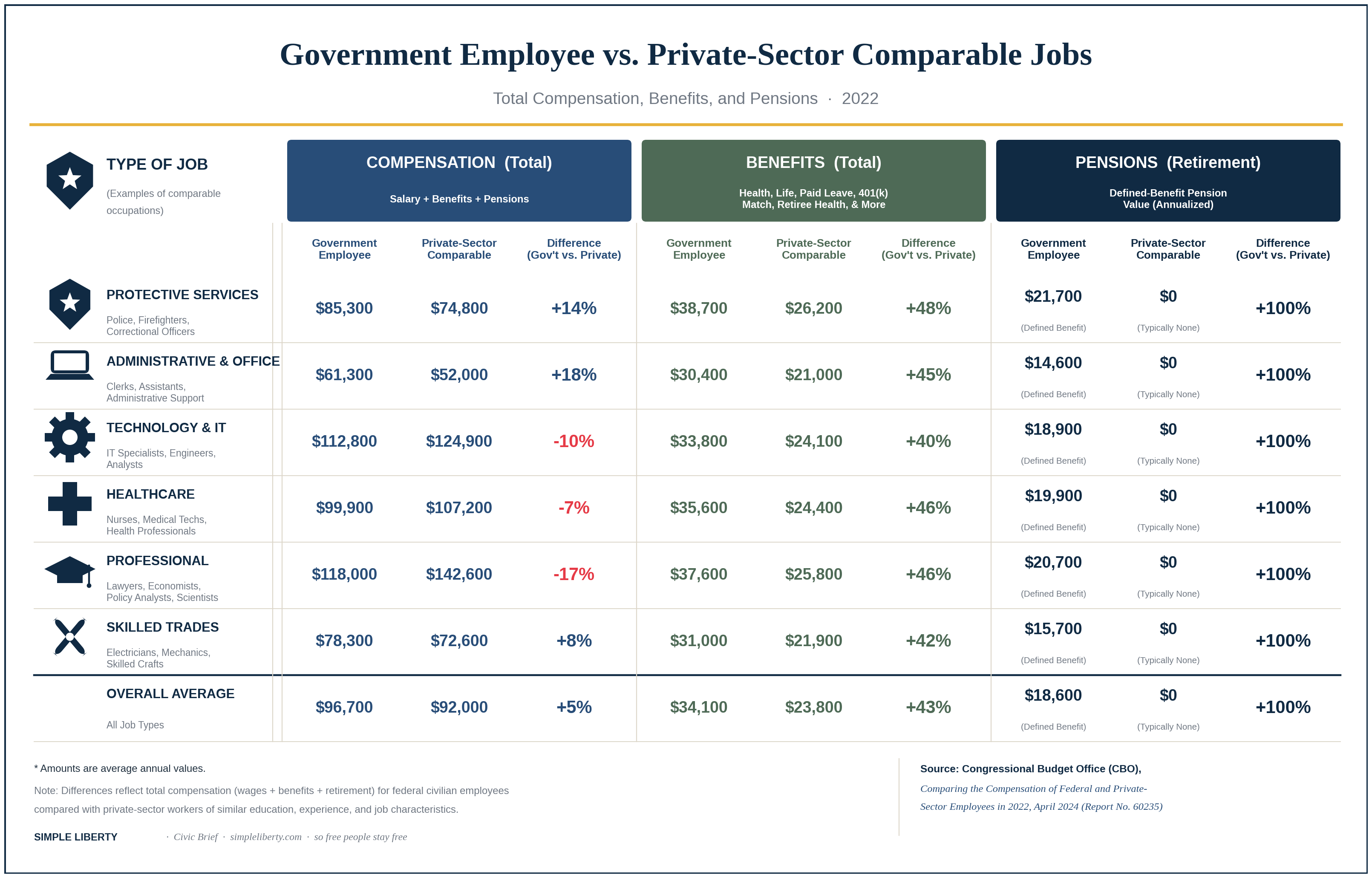
Nothing reveals the lack of integrity and responsibility in Congress more plainly than how we pay those who serve us. A true servant does not out-earn, out-benefit, and out-secure the household they serve. That is our reality today.
Our focus is solutions. This is one major area where both Congress and the President must act if we are to restore our government to its original limitations, stewardship, and stability.
Therefore, a key question: What if the compensation and benefits of elected officials and government employees were brought in line with the citizens they serve?
Payroll Taxes
Every elected official and government employee must pay the same payroll and other taxes that every other American citizen pays. No loopholes.
Not “similar” payroll taxes. The identical tax plan you and I are required to pay.
Benefits
Reform their time off. Today, federal employees earn 13 to 26 paid vacation days a year depending on tenure, may carry 30 days into the next year, accrue 13 sick days annually with no limit on lifetime accumulation, and receive 11 paid holidays.
Do you know anyone who gets this much time off who is not a government employee?
A fairer standard might be: Combine vacation and sick days into PTO. Healthy people should not be penalized for not needing sick days, or encouraged to lie that they’re sick to get equal time off.
Provide 10–20 days PTO annually based on seniority. Cap PTO carryforward at 20 days, with total accrued vacation never exceeding 30 days — use it or lose it. Allow eight paid holidays. (Which holidays remain paid — and whether some are duplicative or unnecessary — is a separate discussion.)
Pensions
The current system has created a protected class of government workers and elected officials who enjoy pension structures, benefits packages, and compensation levels that are increasingly higher than what citizens can earn in comparable careers.
Pensions should be earned and paid in the year they are earned — not deferred into huge, unfunded long-term commitments. No individual may draw more than one government pension from federal, state, and local entities combined.
For existing retirees, there are commitments that have been irresponsibly made. Often pensions and benefits are paid until the death of the former government employee — or their spouse. Every year both benefits increase for inflation. Most jurisdictions offering these benefits — if not all — lack the funds to pay them.
Details matter and should be debated carefully to honor some portion of existing commitments while removing the risk and debt of future pensions and benefits for government employees.
Shift politicians and government employees to only a Social Security pension based on their prior salary, and they should only get the same Medicare options available to common citizens.
Why should politicians and government employees get paid more than common citizens with similar skills?
Public service should be honored. It should also be honest.
ENDNOTES: 24–26

The Mountain Ahead
Let’s be candid: Reforming Congress is tough because so many of the ruling class are profiting from their control of our top legislature.
Reforming the presidency is challenging — but it’s one person. Reforming Congress means confronting 535 politicians, their handlers, and the profit machines that keep them in office. That is 100 senators and 435 representatives in the House.
You can make a difference. Here’s how:
The largest bloc in America is not the left or the right. It is the people who stayed home.
In 2024, roughly 89 million eligible Americans did not vote — more than voted for either candidate. The single most powerful force in this country is standing on the sidelines, convinced their voice does not matter.
They are mistaken.
Their vote matters. Your vote matters. My vote matters. Together, our votes powerfully make a positive difference.
Our elections are often decided at the razor’s edge — control of Congress can turn on a few thousand votes across a handful of districts. The political class is counting on your silence to retain their power. It has for over a century.
Hear this clearly: The answer is not violence. It is not a civil war. The people who profit from our division would like nothing better than for citizens to turn on one another. It would be an excuse for them to claim more power and take away our freedoms. We will not give them the satisfaction.
The answer is older, harder, and far more powerful: We engage — neighbor to neighbor, voter and non-voter alike — with truth, hope, integrity, and transparency.
We get involved developing real solutions to our nation’s biggest problems. We respectfully discuss and refine our solutions, approach, and the impact — so we comprehend the truth, and rally our brothers and sisters to restore the power to the people.
This is the quiet revolution the Founders built the ballot box to carry. Not rage — just passionate, civil, grateful resolve with courageous good character.
The cost is small — a little of our time, our attention, our care. It is time for the people — the citizens of this blessed country — to show up as responsible stewards of our freedom and close the door in tyranny’s face.
We can do this.
This completes our seven questions for Congress — the Legislative branch that makes our laws. Next come seven more, for the Judicial branch — the courts meant to interpret the law, not make it. Each branch has lost its way. Each can be restored — by us.
P.S.
The only hope for America is to restore our covenant to common values, our federal government’s wise three-branch design, and the founding solutions we have abandoned or allowed to be corrupted. Not socialism, communism, a dictatorship, or a monarchy.
A republic where there are true equal rights for all.
Renewal requires us to strengthen our character, protect our rights, and gratefully steward the people’s government for the common good.
Simple Liberty unites everyday Americans to research the facts behind our nation’s biggest problems and develop solutions for the common good — because politicians and billionaires won’t do it for us.
ENDNOTES
These references are meant to introduce you to the data, not provide every source. We encourage you to explore more on your own, and welcome your submissions as comments on this post.
#1 — WHAT IF… Character Actually Mattered?
(1) Potential insider stock trading. Congressional Stock Trading, Explained — Brennan Center for Justice. Documents that nearly all members own public-company stock, the inherent self-dealing risk, and that majorities of both Republican and Democratic voters support a ban. | brennancenter.org
(2) The public overwhelmingly wants good character in politicians. Honesty and Ethics poll — In Gallup’s most recent annual survey, 71 percent of Americans rated the honesty and ethical standards of members of Congress as “low” or “very low” — the worst of any profession measured — while only 7 percent rated them “high” or “very high.” The low rating crossed party lines. The public’s demand for character in Congress is bipartisan and overwhelming. | news.gallup.com
(3) Good character, a precondition set by our Founders. James Madison, Federalist No. 57 (1788) — The aim of every constitution “ought to be, first to obtain for rulers men who possess most wisdom to discern, and most virtue to pursue, the common good,” and then “to take the most effectual precautions for keeping them virtuous whilst they continue to hold their public trust.” The founders were explicit and unanimous on this point. John Adams: “Public virtue is the only foundation of republics.” Benjamin Franklin: “Only a virtuous people are capable of freedom.” Good character in office was not optional to the founders — it was the precondition of the republic itself. | Library of Congress
#2 — WHAT IF… We Eliminated Corruption in Congress?
(4) Felons are serving in Congress. Status of a Member of the House Who Has Been Indicted for or Convicted of a Felony — A felony conviction does not constitutionally disqualify someone from serving in Congress — the only qualifications are age, citizenship, and residency — so a convicted felon may remain in office and even be re-elected. The historical record bears this out: At least 64 House members and 4 senators have been convicted of felonies or serious misdemeanors tied to official conduct, including bribery, fraud, and perjury. Character is not a legal requirement for Congress. It must be a standard we demand. | Congressional Research Service
(5) Politician audits ordered but not happening. The Financial Disclosure Process of the Legislative Branch Can Be Improved — Politicians’ annual financial disclosures are self-reported and essentially never independently verified. There is no audit of what members file against their actual records and no random-sampling program to check accuracy — the ethics committees review filings only for obvious errors and act mainly on outside complaints. A member who omits or misstates a holding may simply never be caught. The Government Accountability Office flagged this verification gap as early as 1981, noting the law itself contemplated audits that were never instituted, and watchdogs continue to call for mandatory random audits by financial professionals as a deterrent. We require ordinary citizens to substantiate their filings to the IRS under threat of audit; we should require no less of those who govern. | U.S. Government Accountability Office
(6) Congressional pensions are self-serving. Federal Retirement: Benefits for Members of Congress — Members of Congress receive a defined-benefit pension under FERS — on top of Social Security and a Thrift Savings Plan with government matching — a three-part retirement most private-sector citizens do not have. Members qualify for a pension after as few as five years of service, and their pension terms are more favorable than those of ordinary federal employees — a member can draw an unreduced pension with 20 years of service at the minimum retirement age, while a regular federal worker needs 30 — and there is no maximum-benefit cap. Those who govern should not retire on terms the governed cannot. | Congressional Research Service
#3 — WHAT IF… No Balanced Budget Meant No Pay?
(7) Politicians paid during shutdown. The 2025 (FY2026) Government Shutdown: Economic Effects — Congressional Research Service, Report R48832. Documents the October 1 – November 12, 2025 shutdown — the longest in modern history at 43 days — and the furlough of non-excepted federal employees. | congress.gov
(8) A counter-perspective on the balanced budget amendment. Constitutional Solutions to Our Escalating National Debt: Examining Balanced Budget Amendments — Brookings Institution. A counter-perspective arguing a balanced budget amendment is unwise, included for an evenhanded view of the debate. | brookings.edu
(9) Bipartisan support to withhold pay. No Pay for Congress During Default or Shutdown — Congress.gov. Members of Congress keep collecting their pay during a government shutdown — even as federal workers, from TSA agents to the military, are forced to work without theirs — because Article I of the Constitution guarantees congressional compensation. Lawmakers from both parties have proposed to change this. The bipartisan No Pay for Congress During Default or Shutdown Act (H.R. 1973, 119th Congress), introduced by Rep. Eugene Vindman (D-VA) and Rep. Brian Fitzpatrick (R-PA), would withhold members’ pay for each day of a shutdown or debt-limit default. To respect the 27th Amendment — James Madison’s original anti-self-dealing protection, which bars mid-term changes to congressional pay — the bill holds the withheld pay in escrow and releases it at the end of the Congress rather than canceling it. In May 2026, the Senate adopted its own version for senators, effective after the November 2026 election. As the bill’s sponsors put it: if you don’t do your job, you don’t get paid — and Congress should be no different. These remain proposals, not yet law. | congress.gov
#4 — WHAT IF… We Right-Sized and Refocused Congress?
(10) Proponents push for expanding the House. Expanding the House of Representatives, Explained — A coalition of scholars and reform groups advocates dramatically enlarging the House of Representatives, frozen at 435 members since 1929 even as the population tripled. Advocates invoke the “cube-root rule” — the finding that peer democracies’ legislatures tend toward the cube root of their population — which for the United States implies roughly 700 members; some propose going further. The American Academy of Arts and Sciences formally recommends expansion (beginning with 585 seats and growing each census), and legislation such as the House Expansion Commission Act (H.R. 2797, 119th Congress) would commission a federal plan to enlarge the House. Proponents argue smaller districts mean closer representation; critics warn of cost, logistics, and simply adding more politicians. | amacad.org
(11) Increasing the body is a power play. Lesson from the Roman Republic — World History Encyclopedia. The Roman Senate held near 300 members through the stable centuries of the Republic. In its final, collapsing decades, strongmen inflated it for their own ends — Sulla to roughly 600, then Julius Caesar to 900, packing it with loyalists, which historians note neutered the Senate’s independence and power. As the Republic gave way to one-man rule, Augustus reduced it again to 600 — still double its original size. The lesson of Rome is that its legislature was inflated and packed by strongmen to concentrate their own power — stripping the Senate of independence as the Republic became an empire. A free people must guard the independence of its representative institutions. | worldhistory.org
(12) The permanent campaign. The 118th Congress’s Fundraising Treadmill — Issue One. A two-year House term means members start running for re-election the day they are sworn in. The non-partisan group Issue One found the typical House member seeking re-election in 2024 raised about $2,900 every day of the term — roughly $10,900 a day in competitive seats. Bipartisan bills like the Gallagher (R) – Phillips (D) “On the Clock Act” have tried to bar fundraising while Congress is in session. Longer terms are one way to ease that pressure and free members to govern. | issueone.org
(13) A return to the Founders’ rhythm. Article I, Section 4, U.S. Constitution; U.S. Senate Historical Office — The Constitution requires only that Congress “assemble at least once in every Year,” originally on the first Monday in December — a date chosen to fit an agricultural nation, so citizen-legislators could tend their farms and businesses before serving. From 1789 into the 1930s Congress typically met from December until spring or summer — roughly five or six months — and members, many of them working lawyers, farmers, and merchants, then returned home. The full-time, year-round Congress arrived only with the government’s vast modern growth; the 20th Amendment (1933) moved the annual start to January 3. A lighter, seasonal calendar is thus a restoration of the original design, not a departure from it. | senate.gov
(14) A shrinking legislative calendar. Vital Statistics on Congress — Brookings Institution. This authoritative, non-partisan data series documents a long decline in the number of days Congress actually meets to legislate, even as members spend more time fundraising and campaigning. Scholars tie the modern Washington schedule to the “permanent campaign” and to Congress’s diminished capacity to do its own work. Concentrated working sessions — with real time back home — are one proposed correction. | brookings.edu
(15) Gerrymandering and the courts. Rucho v. Common Cause (2019) — U.S. Supreme Court. The case paired a Republican gerrymander in North Carolina with a Democratic one in Maryland — proof both parties do it. In a 5-4 ruling the Court held that partisan-gerrymandering claims are “nonjusticiable,” beyond the reach of federal courts, explicitly leaving the remedy to the states and Congress. If it is to be fixed, the people’s elected representatives must do it. | oyez.org
#5 — WHAT IF… Congress Reclaimed the Power to Make Our Laws?
(16) The Constitution vests all lawmaking in Congress. Article I, Section 1, U.S. Constitution — “All legislative Powers herein granted shall be vested in a Congress of the United States, which shall consist of a Senate and House of Representatives.” The Framers placed the lawmaking power — and only the lawmaking power — in the branch most directly accountable to the people. Nowhere does the Constitution authorize Congress to transfer that power to unelected officials. | constitution.congress.gov
(17) Congress has delegated its own constitutional charge. Regulations from the Executive in Need of Scrutiny (REINS) Act, H.R. 142, 119th Congress — The bill’s own findings state the problem plainly: Article I grants all legislative power to Congress, yet “over time, Congress has excessively delegated its constitutional charge while failing to conduct appropriate oversight.” The REINS Act would require both chambers to approve any major regulation — roughly $100 million or more in economic impact — before it could take effect, rather than letting it become binding automatically. Versions have passed the House repeatedly since 2011 but have not cleared the Senate. Defenders of the current system counter that agencies supply technical expertise Congress lacks — included for a fair view of the debate. | congress.gov
(18) The courts are beginning to return power to the elected branches. Loper Bright Enterprises v. Raimondo (2024) and West Virginia v. EPA (2022) — In 2024 the Supreme Court overturned the four-decade “Chevron deference” doctrine, which had required judges to defer to agencies’ own interpretations of ambiguous laws; courts must now interpret the law themselves. Two years earlier, in West Virginia v. EPA, the Court held that on questions of vast economic and political significance, an agency must point to clear authorization from Congress — the “major questions doctrine.” Both decisions push lawmaking authority back toward the people’s elected representatives. | oyez.org
(19) Credit for the law, blame for the bureaucrat. Power Without Responsibility: How Congress Abuses the People Through Delegation, David Schoenbrod — Schoenbrod — a former Natural Resources Defense Council attorney, not a small-government partisan — argues that Congress delegates precisely so members can claim credit for a law’s popular goal while shifting blame to the agency for its unpopular costs. Members have described the maneuver in their own hearings as a bipartisan “two-step”: collect credit for the popular-sounding statute, then blame the unelected bureaucrats for how it turns out. Political scientist Morris Fiorina identified the same incentive decades earlier. | govinfo.gov
(20) Where the delegation began. Milestones in the Evolution of the Administrative State — American Academy of Arts and Sciences. For roughly a century Congress wrote the nation’s commercial law itself. That changed in 1887, when it created the Interstate Commerce Commission — the first independent federal regulatory agency — and, as a later Senate report put it, “saw a need for delegating part of the task of regulating commerce.” The intellectual case came the same year in Woodrow Wilson’s essay “The Study of Administration,” which argued expert administrators should be freed from the friction of separation-of-powers politics. Progressive-era reformers in both parties — Theodore Roosevelt as much as Wilson — built on it; the New Deal vastly expanded it. Defenders counter that industrial-age complexity made some delegation unavoidable. | amacad.org
#6 — WHAT IF… Each Member Was Limited to Two Bills Per Year?
(21) The number and length of bills is astounding. Statistics and Historical Comparison — GovTrack. The volume of federal legislation is immense. In a single recent two-year Congress, members introduced more than 19,000 bills and resolutions. The more revealing measure is length: Since World War II, Congress has enacted roughly 4 to 6 million words of new law every two-year Congress — increasingly packed into fewer but far larger bills, the thousand-page omnibus packages few members read in full before voting. The problem is not idleness; it is volume and complexity outpacing deliberation. | govtrack.us
(22) Limiting the number of bills — a state issue for now. Are there too many legislative bills? — Capping how many bills a legislator may introduce is a real, actively debated reform — but at the state level, not in Congress. Several state legislatures impose limits. E.g., Colorado caps members at five bills a year; North Carolina at ten; Idaho recently weighed a 25-bill cap, with proponents arguing it forces “quality over quantity” and frees time for substantive work members can actually read. No such limit exists in Congress, where a member may introduce unlimited bills. The reform is established in statehouses; whether it should rise to Congress is an open question. | Idaho Capital Sun / Mountain States Policy Center
(23) Earmarks are too often corrupt. Earmark Elimination Act — Earmarks — directing federal money to a specific project or recipient outside the normal merit-based process — were banned by Congress in 2011, then quietly revived in 2021 as “Community Project Funding.” A bipartisan Senate coalition has repeatedly proposed a permanent ban, arguing the practice “breeds corruption, leads to egregious overspending, and places the needs of special interests before those of the American people.” Reformers note an honest caveat: banning earmarks saves little money directly, since they only redirect funds already appropriated — the real case against them is corruption, favoritism, and the erosion of public trust. Others defend earmarks as a transparent tool for legislators to serve their districts. | U.S. Senator Joni Ernst + The Heritage Foundation
#7 — WHAT IF… Government Service Meant Compensation Comparable to Citizens?
(24) Disagreement of magnitude — more facts needed. Comparing the Compensation of Federal and Private-Sector Employees, 2011 to 2015 — Congressional Budget Office. For most workers, total compensation is higher in the federal government than in the private sector for people with similar measurable characteristics — education, experience, occupation, and location. The nonpartisan Congressional Budget Office found that, overall, the federal government paid 17 percent more in total compensation than it would have if pay had matched comparable private-sector workers. The advantage is concentrated among less-educated workers (53 percent higher for those with a high school education or less, 21 percent higher for those with a bachelor’s degree) and reverses at the top (18 percent lower for those with a professional degree or doctorate). CBO cautions its comparison cannot capture unmeasured traits such as motivation or effort. | cbo.gov
(25) Current benefits well above the private sector. The Facts on Federal Health, Leave, and Holidays — Beyond wages, federal employees receive notably generous current benefits. The Congressional Budget Office found the cost of benefits was 47 percent higher for federal workers than for comparable private-sector employees. The specifics are set by federal policy: 11 paid holidays a year; 13 paid sick days annually, with no limit on how much unused sick leave can accumulate over a career; and paid vacation that rises with service from 13 days in the first three years to 20 days, and to 26 days after fifteen years. Health coverage comes through the Federal Employees Health Benefits Program, which offers the widest choice of plans of any U.S. employer, with the government paying roughly 70 percent of the premium. | cbo.gov; opm.gov
(26) Federal Employees’ Retirement System. Federal Employees’ Retirement System — Congressional Research Service. The largest single driver of the federal benefits advantage is retirement. Federal employees receive a three-part retirement most private-sector workers no longer have: A defined-benefit FERS pension, Social Security, and a Thrift Savings Plan with government matching up to 5 percent of pay. The Congressional Budget Office identifies the defined-benefit pension — now rare in private employment — as the single most important factor making federal benefits more costly than comparable private-sector benefits. Defined-benefit pensions, which guarantee lifetime income regardless of market performance, have largely vanished from the private sector, where most workers now rely on 401(k)-style accounts alone. | cbo.gov; Congressional Research Service