


Every adult must maintain a current government-issued photo ID verifying identity and citizenship status.
Meaning ┃ Evidence ┃ Impact ┃Solution ┃Summary
What Does This Claim Mean?
Evidence is noted in [ ]
I. The Claim
This claim proposes a universal identity standard. Every adult in the United States must hold - and keep current - one government-issued photo identification document, or one for each purpose, that verifies who they are, confirms federal authorization for them to be on American soil, and records their citizenship status.
Five phrases carry the weight of the claim, and each has a precise meaning.
A. “Every adult”
This requirement applies to every adult resident or visitor, not only citizens. Adult defined as eighteen years old or older.
B. “Must hold and keep current”
This is a requirement to possess, not a requirement to carry it at all times. The obligation is administrative and continuous: Obtain the credential, keep it unexpired, and update it when name or address changes - the same requirement that already attaches to a driver’s license.
A duty to produce identification on demand, or to answer for its absence, is a different law with its own consequences, and is not part of this claim. Section VI discusses this.
C. “Verifies who they are”
Verification means two things:
Authentication - the holder is the person the credential names. This is the purpose of a photograph, a signature, and a document check.
Uniqueness - one person holds one identity record. No enrollment under more than one name, no identity built from the records of dead people, no single individual appearing in the system as multiple different people.
Authentication without uniqueness is a risk to public safety. This credential lacks value if the system to maintain it is flawed, or corrupt individuals intentionally violate the process. In these two instances, a credential can be genuine and correctly matched to its holder, but allow an individual to have multiple apparently valid credentials.
This is unacceptable because each additional identity is an opportunity for financial crime, evading a criminal record or a protective order, and/or violence committed by someone the system cannot trace.
Thus, this claim asserts uniqueness as a requirement. A card cannot confirm uniqueness by itself. The only way to know a person is not already enrolled under another name is to compare something about the person - not something about the document - against everyone already enrolled.
This means biometrics are needed. This claim adopts the standard proven at national scale: Ten fingerprints and both iris images, collected once at enrollment and checked against the shared record before a credential is issued. Neither method alone is sufficient at this size. Used together, they produce more than ten times fewer errors than either produces alone.
The shared record that makes the check possible, and the statutory limits that must govern every other use of it, are set out in Section XIII.
D. “Confirms federal authorization for them to be on American soil”
The credential confirms the holder’s lawful status: Citizen, lawful permanent resident, or a visitor authorized for a stated term. Where the authorization has an end date, the credential shows it.
This requirement does not grant permission to be in the country. Immigration status is determined by the State Department and Department of Homeland Security.
A key purpose of this credential is to confirm existing federal determination on a person’s identification card, so an employer, benefits agency, or licensing board can confirm what the government already decided rather than guessing or going to the expense of confirming on its own.
Today the REAL ID standard verifies lawful status when the person registers, but the card does not display the status. Section IV sets out what that costs.
E. “Records their citizenship status”
The credential, or a separate credential meeting these requirements, records citizenship status. A citizen’s card records citizenship; a lawful resident’s card records lawful residence and the term of that authorization.
This claim proposes that the recorded status be legible on the credential itself.
F. What the claim would build on
This claim does not invent a document category or the systems to support it. The following programs and systems exist now:
State Department - a federal record of citizenship determinations, held for everyone who has been issued a passport, covering roughly half of American adults.
Department of Homeland Security - a national standard for state-issued photo identification, in the REAL ID Act of 2005, met today by every state.
Department of Homeland Security - a federal biometric repository of more than 320 million identities that holds both citizens and non-citizens and both criminal and non-criminal records, assembled from border crossings, visa applications, background investigations, and arrests.
State motor-vehicle offices - a credential that confirms citizenship, in the Enhanced Driver’s License, issued in five states since 2009, where state offices collect the documents and the federal government designates the result.
Federal Bureau of Investigation - a national fingerprint index, operating since 1983 as part of the criminal justice system and now called Next Generation Identification, covering people who have been arrested.
India’s national identity system - ten-print and iris enrollment operating today at a scale of more than a billion people, demonstrating that the method works at this size.
Three things do not exist:
There is no requirement to hold a single credential that confirms all three requirements and confirms they are current.
No American identification system for the general public collects fingerprints or iris images at credential issuance.
No American record has been built by enrolling the general population - the repositories above were assembled from encounters, so a person who has never had one is not in them.
Section IV sets out what each existing system does today, and what would have to change.
II. The Sub-Claims: What Must Be Proven
The claim has seven sub-claims. Affirming, Dissenting, and Neutral facts for each are presented in Q2 | Evidence, and their outcomes are examined in Q3 | Impact. Sub-claims 1-3 assert the problem is real and important, whereas sub-claims 4-7 assert the absence of unacceptable side effects.
SC-1 - Unverifiable and fraudulent identity causes documented harm to national security and public safety, and that harm is likely undercounted.
SC-2 - Current identity-document systems are insufficient and eroding: Standards are unevenly enforced, issuance is error- and fraud-prone, and counterfeits and AI-generated documents are lowering the cost and raising the amount of identity fraud.
SC-3 - Universal possession of a current, standards-compliant photo ID would reduce the risk to public safety.
SC-4 - All eligible people would be able to obtain and maintain one.
SC-5 - The requirement does not expand government surveillance of law-abiding people: It adds no capability government does not already possess and use, and the credential’s permitted uses are limited by statute.
SC-6 - The cost and effort are justified.
SC-7 - It can be implemented fairly and uniformly, and the process already exists in multiple states.
III. The Credential
This section covers what makes a document qualify at all - who issued it, and what makes it trustworthy. What the document must confirm is the subject of Section IV.
A. “Government-issued”
This term excludes all private credentials - employee badges, membership cards, school IDs issued by private institutions, store accounts. Only a government records the events that establish identity - birth, naturalization, lawful admission - and only a government maintains the records against which those events are checked.
B. What makes a credential secure
The REAL ID Act of 2005 sets the national minimum. An applicant must document full legal name, date of birth, Social Security number, two proofs of principal residence, and lawful status.
The standard also governs the card itself - security features resistant to tampering and counterfeiting - and the issuing office, including verification of the source documents presented.
Every state, the District of Columbia, and the five territories are certified compliant. Compliance is determined by the Department of Homeland Security, not by the state.
C. Qualifying credentials
Under this claim, a credential qualifies if it is issued by a United States government - federal, state, or federally recognized tribal - and meets or exceeds the federal minimum standard.
These typically include REAL ID-compliant state driver’s licenses and identification cards, U.S. passports and passport cards, Enhanced Driver’s Licenses, military identification cards, and tribal identification cards issued by federally recognized tribes, accepted as issued.
D. Source documents are not credentials
A foreign passport with a valid visa and approved admission record is accepted as evidence of identity and lawful status when applying for a state credential. It feeds the verification process. It is not a full qualification on its own.
Foreign documents carry a verification gap that American documents do not. No American authority can check a foreign birth certificate, passport, or consular card against the records of the government that issued it. Documents we cannot verify are more vulnerable to fraud than documents we can, and a credential built on them inherits that vulnerability.
The gap is real: A September 11 hijacker was admitted on a passport carrying fraudulent stamps that the inspector did not detect and, in the 9/11 Commission’s own assessment, could not have been expected to detect.
Every foreign document accepted at an issuance counter can produce a genuine American credential, which means the integrity of American identification depends in part on records the United States cannot audit. This is a vulnerability under SC-2.
E. The non-compliant tier
States also issue credentials that do not meet the federal standard. These cards must state on their face that they are not acceptable for federal purposes, and must be visually distinguishable by unique design or color.
Nineteen states and the District of Columbia issue such credentials to illegal immigrants. To establish who the applicant is, those states accept a foreign birth certificate, foreign passport, or consular card, and in one state a sworn affidavit. Section IV returns to what this tier does and does not confirm.
IV. What the Credential Must Confirm
A. The three requirements
A credential under this claim must answer three questions:
Who are you? The holder is the person the credential names, and that person appears in the system only once.
May you be here? Lawful status - citizen, lawful resident, or authorized visitor.
Are you a citizen? The status that determines which rights and benefits the law reserves.
B. What today’s credentials answer
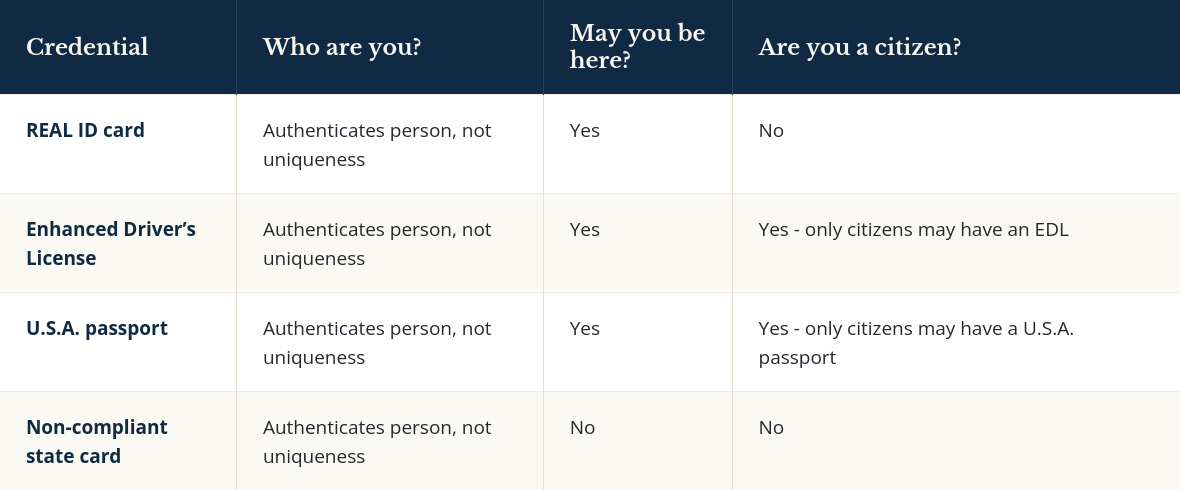
REAL ID cards are issued to lawfully present noncitizens - permanent residents, and holders of employment authorization, Temporary Protected Status, and Deferred Action for Childhood Arrivals among them - with states relying on federal systems to confirm status.
Certain categories receive only limited-term credentials, tied to the expiration of the underlying authorization. One concern is a compliant card issued to a citizen and one issued to a lawful resident may be visually indistinguishable.
REAL ID is the only standard that is national and already met everywhere - and it already meets two of the three requirements.
Enhanced Driver’s License programs meet all three requirements. Offered by Michigan, Minnesota, New York, Vermont, and Washington, an EDL provides federally recognized proof of both identity and U.S. citizenship. Only U.S. citizens who can prove citizenship are eligible; a permanent resident card or work visa will not obtain one. In Washington alone, 2.26 million people hold one - a third of that state’s cardholders.
But the EDL exists in only five states, each under its own separately negotiated federal agreement, and two attempts to add a sixth have failed.
U.S. passports are federally issued rather than state issued, prove citizenship, and are held by about half of adults, but record no fingerprint or iris scan biometric data.
This confirms three facts:
A citizenship-confirming state credential is not hypothetical - it has operated since 2009.
Credentials that meet the three requirements are federally designated, not a state improvisation.
State motor-vehicle offices can collect and forward the documents that establish citizenship, and issue the credentials.
C. What would have to change
The existing structure stops short in three respects:
Status is verified at issuance, but is not consistently legible on the credential.
Standards and timeframes to maintain credentials are inconsistent, and automated renewal can confirm payment without confirming the facts that support continued validity.
Multiple credentials carry overlapping data, and in some cases critical data is missing entirely - so the same facts get verified repeatedly, by different institutions, at their own cost.
Closing these gaps does not require a new agency or a new document. It requires assigning each task to the government agency that already performs it.
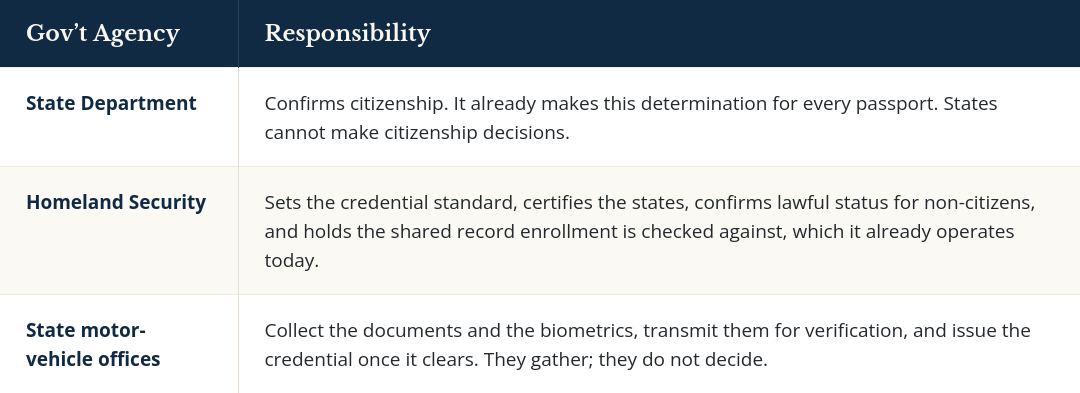
This claim asks for one credential confirming all three requirements, or one confirming the first two and a second to confirm the third: The credential(s) confirms who you are and that you are only one person in the system, whether you may be here, and whether you are a citizen.
Q3 | Impact examines what this would take. Q4 | Solution proposes a draft law.
V. Who Must Comply, and When
The requirement of this claim attaches to presence in the United States, and it scales with the length of that presence.
Visitors present ninety days or less satisfy the requirement with the credential their own government issued, together with the record of American government approval of their admission. The United States does not issue identification to short-term visitors, and their identity has already been verified at the border.
Anyone present longer than ninety days must hold an American government-issued credential meeting this new federal standard. Duration is the trigger, not status: A student on a multi-year visa, a worker on temporary authorization, a permanent resident, and a citizen all must meet this claim’s requirements.
New residents and those reaching adulthood have ninety days - running from their legal arrival in the USA, or the date of their eighteenth birthday - in which to obtain the credential.
The ninety-day line defines who must obtain an American credential and when. Short-term visitors do not - their identity was verified when they were admitted, and they leave before any domestic system needs to know them.
This new law also applies to a large, mostly undocumented population in America. Estimates of the number of illegal immigrants living in the United States range from the federal government’s 11 million to independent estimates of 14 million or more.
Everyone staying longer must meet this standard for national security and public safety reasons, but also because it benefits them. This credential allows them to engage with American institutions: Opening an account, enrolling in school, seeing a doctor, signing a lease, taking a job. These are example situations where identity matters to someone other than the person holding the credential, and where an unverified identity does its damage.
Here is an additional, important detail: The law must count cumulative days an individual is on American soil within a rolling twelve-month period, so the law can eliminate a departure-and-return cycle that resets the person’s permission to be in our country indefinitely. The process to manage that count is examined in Q3 | Impact.
VI. What the Claim Is Not
It is not a carry mandate. This claim does not address how law enforcement uses the credential.
The requirement this claim establishes is to obtain the credential and keep it current. That is all. It does not require anyone to have it on their person at all times, and it does not specify how law enforcement applies the law to do their job.
This claim also carries four requirements whose remaining components are larger than it can settle. They are listed in Section XIII.
VII. What Current Law Does Not Require
No federal law and no state law currently requires an adult to obtain or maintain a current government-issued photo identification document.
Also, no general-purpose federal card that meets the three requirements of this claim is available to an ordinary adult, and Congress has repeatedly declined to create one.
A driver’s license is required to drive; a passport is required to travel abroad; a REAL ID is required to board a commercial aircraft. Each is a condition on an activity, and a person who forgoes the activity has no obligation at all.
The REAL ID Act was drafted to set standards for state credentials rather than to establish a federal card, understood at the time as the constitutionally and politically available path.
The current system is optional, and built on conditional requirements. Due to advancing security threats from technology and AI, this claim proposes the first unconditional identification requirement in American law.
VIII. What Threats This Claim Addresses
This claim addresses three threats to public safety, all of them growing as technology and AI advance. The risks are most significant to those least equipped to recover - the elderly, the poor, and those least familiar with these systems - but affect us all:
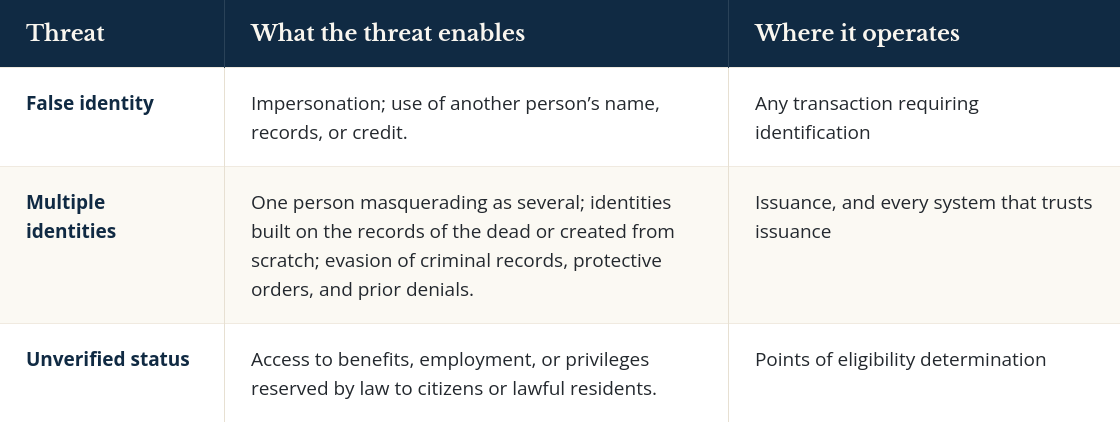
Q2 | Evidence tags each fact to its sub-claim and Q3 | Impact considers its impact.
IX. How Proponents Explain the Claim
Sources: Department of Homeland Security, the 9/11 Commission, national-security policy institutes, immigration-enforcement advocates.
1. Identity is a cornerstone of every other safeguard. Background checks, watchlists, benefit eligibility, and border screening all assume the system knows who a person is. When that assumption is wrong, national security and public safety are at risk.
2. The 9/11 Commission asked for this. It found that the hijackers acquired identification documents that let them operate inside the country, and recommended federal standards for the sources of identification. REAL ID was the response, left half-finished - an optional, incomplete standard rather than a requirement.
3. Fraud is getting cheaper and better. Counterfeit credentials sell online for the price of a fast food meal, and generative tools have lowered the skill required to defeat automated checks.
4. The burden is already borne by nearly everyone. Identification is required to see a doctor, open a bank account, rent an apartment, start a job, buy a car, or board a plane. The claim formalizes an obligation most adults already meet.
5. The cost of the gap falls on the public. Where identity cannot be verified, the cost is absorbed by hospitals, employers, landlords, benefit agencies, and law enforcement - which then increase prices to cover the cost.
6. What identity hides is a public-safety problem. Prior convictions, outstanding warrants, protective orders, and firearm prohibitions attach to a name, and a second false identification eludes capture. The current safeguards are failing, and creating unnecessary risk to the public.
7. Citizenship is a status the law already distinguishes. A credential that cannot confirm citizenship forces institutions to verify it separately, badly, or not at all - at their own additional cost, which is then passed onto the public.
8. The government already runs the systems this would require. Citizenship records, the credential standard, a biometric repository of more than 320 million identities, and a national fingerprint index are all operating today, in the agencies that would carry out this claim (Section F).
X. How Opponents Explain the Claim
Sources: American Civil Liberties Union, Electronic Frontier Foundation, Cato Institute, National Immigration Law Center, and state-sovereignty advocates. Opposition runs from both the civil-libertarian left and the limited-government right.
1. It is an internal passport in substance. A universal credential becomes the key to ordinary life, and a duty to hold it becomes, in practice, a duty to produce it - regardless of what the statute says about carrying.
2. Function creep is the historical rule. The Social Security number was created for a single program and became a universal identifier. Limits written into statute have consistently eroded, and the burden is on proponents to explain why this claim will play out differently.
3. States have already said no, and one has said no by statute. Maine prohibits its own government from using biometric technology to produce identification documents, including facial recognition, fingerprinting, and retinal scanning. California’s legislature passed a citizenship-confirming credential and the governor vetoed it over the tracking risk. Ohio enacted one and never issued a card.
4. A status marking is a marking. A card that displays citizenship makes status visible in every transaction where the card is shown, and invites discrimination that would otherwise require an inquiry no one would make.
5. The infrastructure is the risk. Verifying uniqueness at national scale requires a national record. The database, not the card, is the actual proposal - and databases are breached, subpoenaed, sold, and repurposed - or abused by the government.
6. The burden falls where it always falls. Millions of adults lack a current credential, and obtaining one costs documents, travel, and time. A mandate converts that gap from an inconvenience into a legal violation.
7. REAL ID’s own history is the counter-argument. A standard enacted in 2005 needed roughly two decades and repeated extensions to reach enforcement - evidence that identity infrastructure is harder, slower, and costlier than advocates predict.
8. It is a federal answer to a state question. Identity documents have always been issued by the states, and a national duty shifts authority in a direction the Constitution does not clearly authorize.
XI. Public Opinion
Public support for identity verification is not the same as support for this claim.
Requiring photo identification to vote draws roughly 83 to 84 percent support, with majorities in every partisan group.
A national identification card has historically polled far lower: Gallup found 54 percent support for requiring all adults to carry a government-issued national ID including fingerprints, and Fox News found 55 percent called national ID cards a good idea in 2006, down from 62 percent in 2002.
Three cautions apply:
The national-ID polling is old, taken when security sentiment was unusually high after September 11, 2001, with no comparable recent measurement available.
Those questions asked about carrying a card and about fingerprints - neither of which this claim requires.
The roughly thirty-point gap between the two measures is too large to be explained by wording alone.
Known gap: No current polling tests this claim as stated - a duty to maintain, not carry, a state-issued credential recording citizenship status. Q2 | Evidence records the facts available.
XII. Scenarios the Claim Must Resolve
Adults who have never held identification. A first credential requires source documents - most often a birth certificate - that cost money and time. Who bears that cost, and how the record is reconstructed when missing, must be specified.
Adults who already hold a passport. Their citizenship has already been determined by the federal government, so the expensive step is done. What remains is biometric enrollment, because U.S. passports do not record fingerprints. Whether confirming an existing citizenship record costs materially less than deciding a new one is the question any national schedule depends on, and it has not been measured.
Credentials that expire. A duty to maintain implies a possible moment of non-compliance when a card lapses - whether the holder let it run out or the authorization expired. What follows from that moment, and whether a lapse of authorization is an immigration matter or an administrative one, can significantly affect SC-5.
How identification is renewed. The automated process of driver’s licenses is susceptible to fraud. Automated renewal raises the question of whether identity is re-verified at all, or only payment is confirmed. The process must be specified.
The homeless adult. The federal standard requires two proofs of principal residence. A person without an address cannot satisfy it as written. This is the clearest case of a group the claim would exclude unless it provides otherwise.
The naturalized citizen. A credential recording status must be updated when status changes. Who initiates that update, and how quickly the record follows the fact, must be specified.
The long-staying visitor. A person admitted for a short visit who remains past ninety days crosses the threshold in Section V. How they obtain a credential, and the process to resolve the issue, must be specified.
The person holding multiple identities. Any universal enrollment will encounter people enrolled more than once, some innocently and some not. This claim must specify the process to resolve this issue where applicable.
XIII. Requirements Within This Claim
Each of the following is a requirement of this claim. The requirement is established here. One component of each is larger than this claim can settle, and will be researched separately.
A. Fingerprint and iris scan uniqueness in a shared national database
This claim adopts the biometric standard - ten fingerprints and both iris images at enrollment, stated in Section I(C). This is necessary to confirm uniqueness in a world where falsified information is becoming easier, less expensive, and commonplace due to technology and AI advancements.
Confirming that a person is not already enrolled under another name requires a record shared across states.
The FBI has operated a national fingerprint index since 1983, now called Next Generation Identification, covering people who have been arrested.
The Department of Homeland Security operates a larger one - the Automated Biometric Identification System, holding more than 320 million identities, including citizens and non-citizens, criminal and non-criminal records.
Neither was built by enrolling the general population; both were assembled from encounters.
Extending this standard to everyone raises the question: What may that record be used for, by whom, and under what limit?
This will be researched by our team as a separate claim under the issue of Republic, in the topic of Citizenship.
B. Immigration status verification
A credential that records status can be used to verify visitation and citizenship status, and we believe it should - at the points where the law requires it of citizens or lawful residents.
Examples include employment verification, benefit eligibility, and various types of licensing. What the credential may be checked for, and by whom, is discussed in SC-5.
This claim does not address enforcement, removal, or who should be admitted. This will be researched by our team as a separate claim under the issue of Security, in the topic of Immigration.
C. Voter registration and verification at the polls
Claim #04-003-002 proposes that government-issued photo ID and signature verification be required at the time of voting, and it names this claim as one of its dependencies.
Based on the facts, both are needed: A universal credential recording citizenship makes verified voting simpler and more accurate, and verified voting is one of the strongest public justifications for the credential.
Each is a significant change to American law. Both increase trust in our government systems, protect the integrity of citizenship, and strengthen the simplicity of identification verification for activities involving the public safety.
This has been researched by our team as a separate claim under the issue of Elections, in the topic of Election Integrity.
D. Issuance integrity
The value of any credential depends entirely on the integrity of the organization, individuals, and process that issues it. A fraudulently obtained genuine credential defeats most every check downstream.
Issuance integrity is named in SC-2, and Q2 | Evidence treats failures of issuance as evidence bearing directly on whether current systems are secure, and whether consequences for knowingly violating the law are quick and meaningful.
However, the process to improve issuance integrity is a separate claim. This will be researched by our team as a separate claim under the issue of Security, in the topic of National Defense.
XIV. Conclusion
This claim proposes that every adult in the United States hold and keep one current government-issued photo credential that establishes who they are and they appear in the system only once; their lawful status, meaning their right to be on American soil; and whether they are a citizen.
Ideally this is a single card. Where one card cannot yet answer all three questions, the requirement may be met by credentials that meet this standard and together establish identity, lawful status, and citizenship.
It builds on a federal standard that already exists in the REAL ID program, and Enhanced Driver’s Licenses - a citizenship-confirming credential that already operates in five states. Today both are voluntary, and identification is required only as a condition of some activity a person may decline.
This claim does not require citizens and visitors to carry this identification at all times, nor does it specify law enforcement’s policies to confirm individual identity and consequences.
Its validity rests on seven sub-claims outlined in Section II above.
We recognize and respect concerns regarding the fifth sub-claim. We will work through that and the others in Q2 | Evidence, Q3 | Impact, and Q4 | Solution.
We encourage you to consider the facts in Q2 | Evidence, the effects of this potential law in Q3 | Impact, and what’s the best solution for the common good in Q4 | Solution.