


Every adult must maintain a current government-issued photo ID verifying identity and citizenship status.
Meaning ┃ Evidence ┃ Impact ┃Solution ┃Summary
Why Is This Claim True?
Welcome!
This section is the factual registry for Claim #01-004-001. Its focus is facts, not arguments: Every entry states one verifiable fact in a single sentence, cites the end source - the statute, court record, official report, database, or study where the fact terminates - and identifies the sub-claim it bears on.
Arguments and interpretations remain in Q1 | Meaning (Sections IX-X) and Q3 | Impact, cited to the parties who make them. No opinion piece is cited here as if it were a fact.
The three lanes - Evidence is numbered as follows:
▪ A-# | Affirming - facts a proponent would introduce to support this claim.
▪ D-# | Dissenting - facts an opponent would introduce to discredit this claim.
▪ N-# | Neutral - statutes, official counts, agency records, and facts both sides might introduce.
Evidence numbering
▪ Fact numbers are permanent and global. Once assigned, a six-digit number is never reused or reassigned, and the same fact carries the same number in every claim where it appears.
▪ The lane letter is not part of the number. It records where this claim places the fact. The same fact may sit in a different lane in a different claim - see the note below.
▪ The digits encode nothing. Not source type, not origin claim, not date. They are a plain sequence.
▪ Sources can be repeated - one source may support multiple entries in any lane.
▪ Every fact must include a link to the source; a fact that cannot be traced to a primary source does not enter the registry.
▪ Sub-claim tags use SC-1 through SC-7, matching Q1 | Meaning, Section II. Sub-claim tags are claim-relative: SC-1 here is unrelated to SC-1 in any other claim.
Sub-claim key
▪ SC-1 - Unverified identity causes real harm, likely undercounted.
▪ SC-2 - Current systems are insufficient and getting weaker.
▪ SC-3 - A universal standard would reduce the harm.
▪ SC-4 - All eligible people would be able to obtain and maintain one.
▪ SC-5 - It does not expand surveillance; uses are limited by statute.
▪ SC-6 - The cost and effort are justified.
▪ SC-7 - It can be implemented fairly and uniformly, and the process already exists in multiple states.
DISCLAIMER
Listing evidence in one of these three lanes does not mean we endorse it as true. We verify two things: The lane - Affirming, Dissenting, Neutral - and that each source states the fact we summarize.
Be aware that many “facts” presented by organizations and individuals have a bias. We have included all “facts” we believe are worthy of consideration, even those that end up dissenting with our proposed solution for the common good, or are neutral on it (could go either way).
Some reasons for the bias are studies rest on assumptions that can be biased; surveys are estimates, not full counts; and people on all sides of an issue do research with the intent to prove themselves right.
As we continue to expand our library of issues, some facts will be listed in multiple claims, and sometimes sit in different lanes - Affirming, Dissenting, or Neutral - because of how they relate to each claim.
Follow the links and judge the evidence for yourself. We provide our conclusions in the Q3 | Impact and Q4 | Solution sections of this claim.
Affirming Facts (A)
A-000013 | SC-2 - In February 2024, journalists documented an underground service, OnlyFake, selling realistic fake-ID images for $15 - advertised as neural-network generated at up to 20,000 documents per day - including a fabricated California driver’s license that passed the automated identity check of a major cryptocurrency exchange.
Source: 404 Media (Feb. 2024). Later forensic analysis questioned how much AI the service actually used; the cost, speed, and successful verification bypass are documented regardless.
Links:
▪ 404 Media: https://www.404media.co/inside-the-underground-site-where-ai-neural-networks-churns-out-fake-ids-onlyfake/
▪ Analysis of the AI claim: https://resistant.ai/blog/onlyfake-generative-ai-fraud
A-000014 | SC-2 - The U.S. Treasury’s Financial Crimes Enforcement Network issued an alert in November 2024 reporting an increase in suspicious-activity filings describing deepfake media - including identity documents created or altered with generative AI - used to circumvent identity verification at financial institutions.
Source: FinCEN, Alert FIN-2024-Alert004 (Nov. 13, 2024).
Links:
▪ Official alert (PDF): https://www.fincen.gov/sites/default/files/shared/FinCEN-Alert-DeepFakes-Alert508FINAL.pdf
▪ Press release: https://www.fincen.gov/news/news-releases/fincen-issues-alert-fraud-schemes-involving-deepfake-media-targeting-financial
A-000059 | SC-1, SC-2 - A software flaw in New Jersey’s motor-vehicle system registered roughly 6,600 noncitizens to vote between June 2023 and June 2024 - enrolling applicants even though they answered “no” to the citizenship question - and the error took a year to fix and was not disclosed until July 2026.
Source: Governor’s announcement (July 21, 2026); NBC News; New Jersey Monitor. Responsibility is contested and a federal investigation is open; figures may change.
Links:
▪ New Jersey Monitor: https://newjerseymonitor.com/2026/07/21/governor-software-error-non-citizens-register-vote/
A-000060 | SC-1, SC-2 - Oregon’s motor-vehicle system mistakenly registered more than 1,600 people who had not provided proof of citizenship, an error traced to DMV staff mis-selecting document types and discovered only in 2024.
Source: Oregon Secretary of State newsroom (Sept. 2024); Associated Press (Sept. 30, 2024).
Links:
▪ Oregon Secretary of State: https://apps.oregon.gov/oregon-newsroom/OR/SOS/Posts/Post/dmv-potential-ineligible-voters-improper-registration-records
A-000065 | SC-1 - The 9/11 Commission found that all but one of the nineteen hijackers acquired some form of U.S. identification document, some by fraud, and that these documents assisted them in boarding commercial flights, renting cars, and other necessary activities.
Source: The 9/11 Commission Report, Final Report of the National Commission on Terrorist Attacks upon the United States (2004), pp. 384, 390; quoted in DHS written testimony to the House Judiciary Committee (Mar. 2012).
Links:
▪ DHS testimony quoting the report: https://www.dhs.gov/real-id/news/2012/03/21/written-testimony-plcy-house-committee-judiciary-subcommittee-crime-terrorism-and
▪ GAO summary of Commission recommendations: https://www.gao.gov/products/b-303692
A-000066 | SC-1, SC-2 - The 9/11 Commission recommended that the federal government set standards for the issuance of birth certificates and sources of identification such as driver’s licenses, finding that at many entry points to vulnerable facilities, sources of identification are the last opportunity to confirm that people are who they say they are.
Source: The 9/11 Commission Report (2004), p. 390; recommendation catalogued by GAO and quoted in the Senate report on the 2009 PASS ID bill.
Links:
▪ GAO, Summary of Recommendations: https://www.gao.gov/products/b-303692
▪ S. Rept. 111-104 (quoting p. 390): https://www.congress.gov/committee-report/111th-congress/senate-report/104
A-000067 | SC-1 - The Federal Trade Commission received more than 1.1 million identity theft reports in 2024.
Source: Federal Trade Commission, Consumer Sentinel Network Data Book 2024 (Mar. 10, 2025). The Data Book is based on unverified reports filed by consumers and is not a consumer survey. Note: The FTC publishes report counts for identity theft but does not publish a dollar-loss figure for it.
Links:
▪ Data Book 2024: https://www.ftc.gov/reports/consumer-sentinel-network-data-book-2024
▪ Interactive data: https://www.ftc.gov/exploredata
A-000068 | SC-1, SC-2 - The Federal Reserve identifies synthetic identity fraud - fictitious people built on a real Social Security number combined with fabricated details - as the fastest-growing type of identity theft in the United States, with the numbers most often taken from children, the elderly, the homeless, and the deceased because the theft goes undetected for years.
Source: Federal Reserve Bank of Boston, “A victimless crime? Hardly” (Aug. 2022), reporting Federal Reserve synthetic identity fraud research; losses estimated at $20 billion in 2020.
Links:
▪ Federal Reserve Bank of Boston: https://www.bostonfed.org/news-and-events/news/2022/08/synthetic-identity-fraud-is-not-a-victimless-crime-costs-billions-damages-lives.aspx
A-000069 | SC-2 - The Federal Reserve Bank of Boston reports that generative AI is being used to automate the creation of synthetic identities and to make them appear legitimate - including by fabricating supporting records such as synthetic parents - drawing on data from thousands of breaches compromising hundreds of millions of records.
Source: Federal Reserve Bank of Boston, “Gen AI is ramping up the threat of synthetic identity fraud” (Apr. 2025).
Links:
▪ Federal Reserve Bank of Boston: https://www.bostonfed.org/news-and-events/news/2025/04/synthetic-identity-fraud-financial-fraud-expanding-because-of-generative-artificial-intelligence.aspx
A-000070 | SC-3, SC-4, SC-7 - When REAL ID enforcement began at airport checkpoints on May 7, 2025, 81 percent of travelers already presented compliant identification; within two weeks the figure was 93 percent, and by December 2025 TSA reported more than 94 percent.
Source: Transportation Security Administration press releases (Apr. 11, May 21, and Dec. 1, 2025); Department of Homeland Security (May 7, 2025).
Links:
▪ TSA, enforcement begins (81%): https://www.tsa.gov/news/press/releases/2025/04/11/tsa-begins-real-id-full-enforcement-may-7
▪ TSA, two weeks in (93%): https://www.tsa.gov/news/press/releases/2025/05/21/tsa-reminds-public-real-id-enforcement-continues
▪ TSA, December 2025 (94%+): https://www.tsa.gov/news/press/releases/2025/12/01/tsa-introduces-new-45-fee-option-for-travelers-without-real-id
▪ DHS announcement: https://www.dhs.gov/news/2025/05/07/tsa-begins-real-id-full-enforcement
A-000071 | SC-5 - Federal law already restricts what may be done with the personal information a state motor-vehicle department collects: The Driver’s Privacy Protection Act of 1994 prohibits release or use of that information except for fourteen enumerated permissible uses, sets penalties, and makes violators liable in a civil action to the individual whose information was released.
Source: 18 U.S.C. § 2721 et seq. (Driver’s Privacy Protection Act), Pub. L. 103-322 as amended; summarized by the Electronic Privacy Information Center.
Links:
▪ EPIC summary of the DPPA: https://epic.org/dppa/
A-000072 | SC-5 - The Supreme Court has enforced those statutory limits in both directions - upholding the DPPA against a state challenge in Reno v. Condon (2000), and in Maracich v. Spears (2013) holding that obtaining driver information to solicit clients falls outside the statute’s litigation exception.
Source: Reno v. Condon, 528 U.S. 141 (2000); Maracich v. Spears, 570 U.S. 48 (2013).
Links:
▪ Case summaries and DPPA background: https://epic.org/dppa/
A-000073 | SC-5 - Government capability to track individuals already operates at national scale and is independent of any identity credential: A public mapping project counts roughly 119,000 automated license plate reader cameras deployed across the United States.
Source: DeFlock mapping project, reported by Fox News (2026); Congressional Research Service background on ALPR systems.
Links:
▪ Reporting on the camera count: https://www.foxnews.com/tech/license-plate-cameras-tracking-drivers-everywhere
▪ CRS, ALPR background and legal issues: https://www.congress.gov/crs-product/IF13068
▪ CRS, law enforcement use of ALPRs: https://www.congress.gov/crs-product/R48160
A-000074 | SC-1 - U.S. consumers lost an estimated $27.3 billion to identity fraud in 2025, and the Identity Theft Resource Center logged a record 3,322 U.S. data compromises that year, with 80 percent of surveyed consumers reporting they had received at least one breach notice in the preceding twelve months.
Source: Javelin Strategy & Research (2026); Identity Theft Resource Center, 2025 Annual Data Breach Report. (Industry estimates, not official counts.)
Links:
▪ Reporting on both figures: https://www.foxnews.com/tech/last-years-breach-years-identity-fraud
A-000075 | SC-3, SC-7 - A national fingerprint-based identity system already exists and has operated for decades: The FBI’s Interstate Identification Index links the criminal history repositories of the FBI and participating states into a single national network, every record in it is supported by a fingerprint submission, and it has been in operation since 1983.
Source: Federal Bureau of Investigation, Criminal Justice Information Services Division, IAFIS/NGI Biometric Interoperability documentation; Bureau of Justice Statistics, Comparison of Criminal-History Information Systems.
Links:
▪ FBI CJIS description of the III: https://www.fbi.gov/how-we-can-help-you/more-fbi-services-and-information/freedom-of-information-privacy-act/department-of-justice-fbi-privacy-impact-assessments/iafis-ngi-biometric-interoperability
▪ Bureau of Justice Statistics report (PDF): https://www.ojp.gov/pdffiles1/bjs/grants/253816.pdf
▪ FBI, Identity History Summary Checks: https://le.fbi.gov/informational-tools/identity-history-summary-checks
A-000076 | SC-1, SC-3 - A state law-enforcement agency states in its public guidance that it is common for criminal offenders to use false or alias names and dates of birth that a name-based records request will not detect, and that fingerprints are the only positive means of identification.
Source: Illinois State Police, “Guide to Understanding Criminal History Record Check Information,” published by the Illinois Department of Public Health.
Links:
▪ Illinois guidance (PDF): https://dph.illinois.gov/content/dam/soi/en/web/idph/files/forms/background-check-guide-071817.pdf
A-000077 | SC-2 - U.S. Customs and Border Protection officers at Chicago’s international mail facility seized 19,888 counterfeit U.S. driver’s licenses in 1,513 shipments during the first six months of 2020, arriving mostly from China and Hong Kong and destined for addresses across the United States.
Source: U.S. Customs and Border Protection, local media release (July 2020).
Links:
▪ CBP release: https://www.cbp.gov/newsroom/local-media-release/over-19k-fraudulent-ids-seized-cbp-officers-chicago
A-000078 | SC-2 - The volume has continued: CBP officers in Louisville seized 7,789 counterfeit driver’s licenses across three shipments in a fourteen-day span in October 2022, and CBP in Chicago seized 4,345 counterfeit licenses in 485 shipments during a single month in 2025.
Source: U.S. Customs and Border Protection, local media releases (Oct. 2022; May 2025).
Links:
▪ CBP Louisville, October 2022: https://www.cbp.gov/newsroom/local-media-release/2-shipments-containing-4420-counterfeit-driver-s-licenses-seized-cbp
▪ CBP Chicago, 2025 (reported): https://www.upi.com/Top_News/US/2025/05/01/CBP-intercepts-counterfeit-watches-licenses/2421746120109/
A-000079 | SC-1, SC-2 - CBP reported two specific findings in the seized documents: Many counterfeit licenses shared the same photograph with different biographical data, and the barcode on counterfeit Michigan licenses functioned correctly when scanned.
Source: U.S. Customs and Border Protection, local media releases (2020).
Links:
▪ CBP Chicago release: https://www.cbp.gov/newsroom/local-media-release/over-19k-fraudulent-ids-seized-cbp-officers-chicago
▪ CBP Cincinnati release (same photograph, different names): https://www.cbp.gov/newsroom/local-media-release/cincinnati-cbp-officers-seize-over-2200-fraudulent-ids-year-0
A-000080 | SC-1, SC-2 - CBP states that counterfeit identification documents are used by foreign terrorist organizations, criminal organizations, and persons involved in fraud schemes to avoid attracting attention to illegal activity, and that such documents can support identity theft, human smuggling, and human trafficking.
Source: U.S. Customs and Border Protection, statements of area port directors in agency media releases (2020; 2025).
Links:
▪ CBP Louisville: https://www.cbp.gov/newsroom/local-media-release/cbp-louisville-seizes-more-5000-fake-ids
▪ CBP Dallas-Fort Worth: https://www.cbp.gov/newsroom/local-media-release/cbp-intercepts-counterfeit-driver-s-licenses
A-000084 | SC-6 - Lacking a compliant credential already carries a direct price: Beginning February 1, 2026, TSA charges $45 to a traveler who arrives without an acceptable identification document and must use its identity-verification process instead.
Source: Transportation Security Administration press release (Dec. 1, 2025). Note: This fee exists because REAL ID enforcement exists, so it measures the cost of non-compliance with a standard this claim would extend, not a cost that would arise on its own.
Links:
▪ TSA announcement: https://www.tsa.gov/news/press/releases/2025/12/01/tsa-introduces-new-45-fee-option-for-travelers-without-real-id
A-000103 | SC-5 - A declassified report by the Director of National Intelligence found that the intelligence community purchases increasing volumes of commercially available information, including sensitive location data, and does not know how much it collects, what types, or what it does with the data.
Source: ODNI Senior Advisory Group, Report on Commercially Available Information (Jan. 2022, declassified June 2023). Released in response to oversight by Senator Ron Wyden and a FOIA request from the Electronic Privacy Information Center.
Links:
▪ ODNI declassified report (PDF): https://www.dni.gov/files/ODNI/documents/assessments/ODNI-Declassified-Report-on-CAI-January2022.pdf
▪ ODNI release announcement: https://www.dni.gov/index.php/newsroom/reports-publications/reports-publications-2023/3700-odni-senior-advisory-group-panel-declassified-report-on-commercially-available-information
▪ EPIC analysis of the findings: https://epic.org/odni-report-on-intelligence-agencies-data-purchases-underscores-urgency-of-reform/
A-000104 | SC-5 - The same ODNI report states that government would never have been permitted to compel billions of people to carry location tracking devices, to log and track most of their social interactions, or to keep flawless records of their reading habits - yet smartphones, connected cars, web tracking technologies, and the Internet of Things produced that effect without government participation.
Source: ODNI Senior Advisory Group, Report on Commercially Available Information (Jan. 2022, declassified June 2023).
Links:
▪ ODNI declassified report (PDF): https://www.dni.gov/files/ODNI/documents/assessments/ODNI-Declassified-Report-on-CAI-January2022.pdf
A-000105 | SC-5 - Federal agencies including the FBI, Secret Service, Internal Revenue Service, Drug Enforcement Administration, and U.S. Special Operations Command have purchased aggregated smartphone location data from commercial brokers, and records obtained through FOIA litigation confirm that Immigration and Customs Enforcement and Customs and Border Protection bought bulk access to cellphone location information harvested from smartphone applications.
Source: Center for Strategic and International Studies, “Digital Dragnets: Examining the Government’s Access to Your Personal Data”; American Civil Liberties Union FOIA litigation against DHS (filed Dec. 2020). The purchases occur without the advance judicial review that would ordinarily attend government-compelled acquisition of comparable records.
Links:
▪ CSIS analysis: https://www.csis.org/analysis/digital-dragnets-examining-governments-access-your-personal-data
▪ Brennan Center on federal data purchases: https://www.brennancenter.org/our-work/analysis-opinion/federal-agencies-are-secretly-buying-consumer-data
A-000106 | SC-5 - Clearview AI has been awarded contracts with more than 3,000 U.S. federal, state, and local government agencies and claims to have scraped over 10 billion images, while the FBI’s own internal photo database holds roughly 640 million images.
Source: Center for Strategic and International Studies, “Digital Dragnets” (2026).
Links:
▪ CSIS analysis: https://www.csis.org/analysis/digital-dragnets-examining-governments-access-your-personal-data
A-000107 | SC-5 - The Government Accountability Office found five federal agencies using facial recognition technology to monitor or surveil locations in order to determine whether a specific individual is present, including persons on watchlists.
Source: GAO, “Facial Recognition Technology: Current and Planned Uses by Federal Agencies,” GAO-21-526 (Aug. 2021).
Links:
▪ GAO report page: https://www.gao.gov/products/gao-21-526
▪ Full report (PDF): https://www.gao.gov/assets/gao-21-526.pdf
A-000108 | SC-5 - The FBI conducted more than 3.3 million queries of Americans’ communications against its Section 702 holdings between December 2020 and November 2021, up from approximately 1.3 million the previous year - warrantless searches under an authority nominally limited to targeting foreigners located outside the United States.
Source: ODNI Annual Statistical Transparency Report, cited in a joint oversight letter from the House Committee on the Judiciary and the House Permanent Select Committee on Intelligence to the FBI Director (May 24, 2022).
Links:
▪ House oversight letter (PDF): https://intelligence.house.gov/uploadedfiles/20220524_jdj_mt_to_wray_fisa_97.pdf
▪ CRS background on Section 702: https://www.congress.gov/crs-product/R48592
A-000113 | SC-1, SC-2 - The federal government does not count the unlawfully present population; it estimates it by subtraction. The residual method estimates all foreign-born residents, subtracts an estimate of the lawfully present, and treats the remainder as unauthorized.
Source: Social Security Bulletin, “Measuring the Number of Unauthorized Immigrants in the United States: A Review of the Residual Estimation Method,” Vol. 85 No. 2; Congressional Research Service, “Unauthorized Immigrants: Frequently Asked Questions” (R47218). Note: This is the methodological fact underneath every population figure in this registry. No system records these people, so every number is inferred.
Links:
§ Social Security Bulletin review: https://www.ssa.gov/policy/docs/ssb/v85n2/v85n2p1.html
§ CRS report: https://www.congress.gov/crs-product/R47218
A-000116 | SC-2 - The official estimates diverge widely enough that Congress has formally asked DHS to explain the discrepancy - a May 2024 letter to the Secretary of Homeland Security noted that the DHS estimate differs drastically from other studies, one of which concluded the population might exceed 22 million, and requested an updated report.
Source: Congressional letter to the Secretary of Homeland Security (May 2, 2024). Note: The 22 million figure has been publicly critiqued, including by the Center for Immigration Studies. The fact entered here is the divergence and the congressional request, not the accuracy of any single estimate.
Links:
§ Congressional letter (PDF): https://roy.house.gov/sites/evo-subsites/roy.house.gov/files/evo-media-document/Illegal%20Alien%20Population%20Update%20Letter_FINAL%20%282%29.pdf
A-000117 | SC-1 - The share of the unlawfully present population arriving by visa overstay rather than entry without inspection has risen in recent years, meaning a growing portion entered lawfully, were recorded at admission, and then disappeared from the record.
Source: Social Security Bulletin review of estimation methods. Connects to N-000100: 538,548 overstay events in Fiscal Year 2024 alone.
Links:
§ Social Security Bulletin review: https://www.ssa.gov/policy/docs/ssb/v85n2/v85n2p1.html
A-000119 | SC-2 - The nineteen states that issue credentials without proof of lawful status accept foreign source documents to establish identity - a foreign birth certificate, foreign passport, or consular identification card, with a tax identification number in most states, and a sworn affidavit in New Mexico where no tax number exists.
Source: National Conference of State Legislatures; state motor-vehicle requirements. No American authority can verify these records against the government that issued them. See A-000124 for a documented instance in which fraud in a foreign passport went undetected at the border.
Links:
§ NCSL summary: https://www.ncsl.org/immigration/states-offering-driver-s-licenses-to-immigrants
A-000124 | SC-2 - A September 11 hijacker was admitted to the United States on a passport later found to contain fraudulent travel stamps associated with al Qaeda. The inspector who admitted him did not detect the fraud, and the 9/11 Commission staff concluded he could not have been expected to, because the manipulation was not identified by the intelligence community until after the attacks.
Source: National Commission on Terrorist Attacks upon the United States, staff report “9/11 and Terrorist Travel,” Chapter 2.
Links:
§ 9/11 Commission staff report (PDF): https://www.9-11commission.gov/staff_statements/911_TerrTrav_Ch2.pdf
§ Full monograph (PDF): https://www.9-11commission.gov/staff_statements/911_TerrTrav_Monograph.pdf
A-000125 | SC-3, SC-7 - A study commissioned before India built its national identity system found that combining both iris images with all ten fingerprints produced accuracy more than an order of magnitude better than either method used alone. The study analyzed biometric matching for 40,000 people across three rural districts.
Source: Unique Identification Authority of India, “Role of Biometric Technology in Aadhaar Enrollment” (Jan. 2012), reporting the findings of the UIDAI enrollment proof-of-concept study.
Links:
§ UIDAI report (PDF): https://www.dematerialisedid.com/PDFs/role_of_biometric_technology_in_aadhaar_jan21_2012.pdf
A-000126 | SC-3, SC-7 - India’s national identity system confirms that each of more than 1.4 billion enrolled residents holds a single identity record by checking all ten fingerprints, both iris images, and a facial image against the entire database at every enrollment and update.
Source: Unique Identification Authority of India; reporting on the UIDAI biometric platform (Feb. 2026). Enrollment captures a photograph, ten fingerprints, and both iris scans, and each record is compared against every other record before a number is issued.
Links:
§ UIDAI platform reporting: https://idtechwire.com/indias-uidai-deploys-ai-powered-invisible-shield-for-aadhaar-biometric-deduplication/
§ Enrollment process description (PDF): https://arxiv.org/pdf/1510.04160
A-000127 | SC-7 - A state credential that confirms citizenship has been issued at scale: As of October 1, 2025, 2.26 million Washington license and identification card holders held an Enhanced Driver’s License or Enhanced ID, representing 33 percent of that state’s active cardholder population.
Source: Washington State Department of Licensing, Driver Licensing Office Workload Report, 2025 Quarter 3.
Links:
§ WA DOL quarterly report (PDF): https://dol.wa.gov/media/pdf/5020/licensing-office-quarterly-report-2025-q3pdf/download?inline=
A-000128 | SC-7 - The same state absorbed a surge in demand: 168,000 customers received an original Enhanced Driver’s License or Enhanced ID in a single quarter of 2025, a 148 percent increase over the same quarter of 2024, with each original application taking up to five minutes longer than a standard renewal and requiring an in-person visit.
Source: Washington State Department of Licensing, Driver Licensing Office Workload Report, 2025 Quarter 3.
Links:
§ WA DOL quarterly report (PDF): https://dol.wa.gov/media/pdf/5020/licensing-office-quarterly-report-2025-q3pdf/download?inline=
A-000129 | SC-6, SC-7 - The United States has organized a national service program at comparable scale before. More than three million men served in the Civilian Conservation Corps between 1933 and 1942 - described by one historian as the largest peacetime mobilization in American history - with 275,000 enrolled in the first three months and peak enrollment between 300,000 and 500,000 at one time across roughly 2,600 camps.
Source: Living New Deal; National Park Service; Robert D. Leighninger, Jr., Long-Range Public Investment (2007). Note: The Corps recruited during roughly 25 percent unemployment, so its labor supply arose from economic need rather than from willingness to serve. The logistical achievement transfers; the recruiting conditions do not.
Links:
§ Living New Deal summary: https://livingnewdeal.org/glossary/civilian-conservation-corps-ccc-1933/
§ Program history: https://www.history.com/articles/civilian-conservation-corps
A-000130 | SC-7 - The Civilian Conservation Corps was executed jointly by federal and state authority: The Department of Labor recruited, the Army provided transportation and ran the camps, enrollees were supervised by Army Reserve officers, each state carried out its own enrollment under a quota set by state population, and unemployed World War I veterans were specifically included.
Source: New Georgia Encyclopedia; Living New Deal; Oklahoma Historical Society.
Links:
§ Structure and agency roles: https://www.georgiaencyclopedia.org/articles/history-archaeology/civilian-conservation-corps/
§ Living New Deal summary: https://livingnewdeal.org/glossary/civilian-conservation-corps-ccc-1933/
A-000140 | SC-3, SC-5, SC-7 - The Department of Homeland Security already operates a national biometric repository holding more than 320 million unique identities and processing more than 400,000 biometric transactions each day. The system, called the Automated Biometric Identification System, includes both foreign nationals and U.S. citizens, and both criminal and non-criminal records.
Source: Department of Homeland Security, Office of Biometric Identity Management; DHS information paper on data sharing with state, local, tribal, and territorial law enforcement (Apr. 2025). Its partners include Customs and Border Protection, FEMA, the Departments of State, Justice, and Defense, state and local law enforcement, and the intelligence community. It is the second-largest biometric system in the world, behind only India’s.
Links:
§ DHS biometrics overview: https://www.dhs.gov/biometrics
§ OBIM data-sharing information paper (PDF): https://www.dhs.gov/sites/default/files/2025-04/25_0414_obim_data-sharing-sltt-law-enforcement.pdf
§ Office of Biometric Identity Management: https://www.dhs.gov/obim
A-000141 | SC-3, SC-7 - The FBI’s national fingerprint index, operating since 1983 and now called Next Generation Identification, is searched by most law enforcement agencies, and its records can be searched alongside the Department of Homeland Security repository without establishing a new connection.
Source: Department of Homeland Security, Office of Biometric Identity Management information paper (Apr. 2025); Federal Bureau of Investigation, Criminal Justice Information Services Division.
Links:
§ OBIM information paper (PDF): https://www.dhs.gov/sites/default/files/2025-04/25_0414_obim_data-sharing-sltt-law-enforcement.pdf
§ FBI CJIS biometric interoperability: https://www.fbi.gov/how-we-can-help-you/more-fbi-services-and-information/freedom-of-information-privacy-act/department-of-justice-fbi-privacy-impact-assessments/iafis-ngi-biometric-interoperability
A-000144 | SC-2, SC-3 - The current standard fingerprints the clerk, not the applicant. States must conduct name-based and fingerprint-based criminal history records checks against state criminal records and the FBI’s systems on motor-vehicle employees who can affect the identity information appearing on a license, who have access to the production process, or who are involved in manufacturing the cards. Applicants for a compliant credential submit no fingerprints; the only biometric collected is a digital photograph.
Source: REAL ID Act implementing regulations, 6 CFR Part 37; Department of Homeland Security notice of proposed rulemaking (2006); Transportation Security Administration REAL ID guidance.
Links:
§ 6 CFR Part 37: https://www.ecfr.gov/current/title-6/chapter-I/part-37
§ DHS rulemaking notice (PDF): https://www.dhs.gov/xlibrary/assets/nprm_realid.pdf
§ TSA REAL ID guidance: https://www.tsa.gov/realid/realid-faqs
A-000148 | SC-7 - The same doctrine leaves federal preemption intact. Federal law can preempt state regulation in whole or in part, and can condition a state’s ability to regulate an activity on conformity with federal standards. What it cannot do is compel the state to carry out the federal program.
Source: Congressional Research Service, “The Supreme Court Bets Against Commandeering: Murphy v. NCAA, Sports Gambling, and Federalism” (LSB10133, 2018).
Links:
§ CRS analysis: https://www.congress.gov/crs-product/LSB10133
A-000149 | SC-7 - Federal authority is at its strongest where foreign affairs are concerned. In Crosby v. National Foreign Trade Council the Supreme Court struck down a Massachusetts sanctions law as an intrusion on federal foreign policy, and the Constitution assigns naturalization and the regulation of immigration to the federal government.
Source: Crosby v. National Foreign Trade Council, 530 U.S. 363 (2000); U.S. Const. art. I, sec. 8, cl. 4. This is preemption rather than commandeering: It bars states from contradicting the federal determination, not from declining to assist it.
Links:
§ Foreign affairs federalism analysis (PDF): https://lawcat.berkeley.edu/record/1117769/files/fulltext.pdf
§ Constitution Annotated, naturalization power: https://constitution.congress.gov/browse/essay/artI-S8-C4-1/ALDE_00013128/
Dissenting Facts (D)
D-000018 | SC-4 - A national survey estimates that more than 49 million American adults do not possess an unexpired driver’s license bearing their current name and address.
Source: Brennan Center for Justice / University of Maryland Center for Democracy and Civic Engagement national survey (2024). (Survey estimate, n=2,386, weighted.)
Links:
▪ Brennan Center: https://www.brennancenter.org/topics/voting-elections/voting-reform/voter-id
▪ CDCE survey results (PDF): https://cdce.umd.edu/sites/cdce.umd.edu/files/pubs/Voter%20ID%202023%20survey%20Key%20Results%20June%202024%20updatev2.pdf
D-000032 | SC-4, SC-6 - A Harvard Law School institute report calculated that obtaining a nominally free voter identification card typically costs the individual $75 to $175 in underlying documents, travel, and time.
Source: Richard Sobel, “The High Cost of ‘Free’ Photo Voter Identification Cards,” Charles Hamilton Houston Institute, Harvard Law School (2014).
Links:
▪ Harvard Law School summary: https://hls.harvard.edu/today/free-voter-ids-costly-harvard-law-report-finds
D-000081 | SC-4 - The Government Accountability Office found that across the ten states it reviewed, an applicant pays an average of $54 to obtain a state identification card, before any fees for the supporting documents required to apply.
Source: GAO, “Homelessness: Barriers to Obtaining ID and Assistance Provided to Help Gain Access,” GAO-24-105435 (2024).
Links:
▪ GAO report page: https://www.gao.gov/products/gao-24-105435
▪ Full report (PDF): https://www.gao.gov/assets/d24105435.pdf
D-000082 | SC-4 - The same GAO review found that people experiencing homelessness face compounding barriers to obtaining identification: No reliably safe place to store documents, loss or destruction of documents during evictions and encampment clearances, difficulty providing a residential address, inability to pay fees, lack of transportation or technology, and - for homeless youth - inability to obtain parental consent.
Source: GAO-24-105435 (2024).
Links:
▪ GAO report page: https://www.gao.gov/products/gao-24-105435
▪ Full report (PDF): https://www.gao.gov/assets/d24105435.pdf
D-000083 | SC-4 - Advocates documented a recurring circular barrier: Applicants seeking a state ID were told they needed a birth certificate, and applicants seeking a birth certificate were told they needed a photo ID.
Source: National Law Center on Homelessness & Poverty, “Photo Identification Barriers Faced by Homeless Persons” (2004).
Links:
▪ NLCHP report (PDF): https://homelesslaw.org/wp-content/uploads/2019/03/Photo-ID-Barriers-Faced-by-Homeless-Persons-2004.pdf
D-000086 | SC-5 - The Social Security number is the standing example of statutory limits eroding: Created in 1935 for the single purpose of identifying earnings covered by the new program, it became a universal identifier used across government and by credit bureaus, hospitals, and educational institutions.
Source: Cato Institute, “If You Value Privacy, Resist Any Form of National ID Cards.” (Cato is a libertarian policy institute; the history of SSN expansion is independently documented.)
Links:
▪ Cato Institute: https://www.cato.org/commentary/you-value-privacy-resist-any-form-national-id-cards
D-000087 | SC-5 - Statutory and policy limits on identity data have been violated in practice: Officers have been found using automated license plate reader access to stalk former partners and to surveil protestors, and a New York State Inspector General investigation found DMV employees improperly accessing motor-vehicle records in violation of both federal law and department policy.
Source: Center for Democracy and Technology issue brief on ALPRs (2026); New York State Inspector General, DMV database access investigation (2025).
Links:
▪ CDT issue brief: https://cdt.org/insights/cdt-issue-brief-automated-license-plate-readers-alprs/
▪ NY Inspector General report (PDF): https://ig.ny.gov/system/files/documents/2025/11/4.3.25-dmv-improper-accessing-of-dmv-database.pdf
D-000088 | SC-6 - Contemporary estimates of the cost of a national identification system ranged from a minimum of $4 billion to $25-30 billion to establish, plus $3-6 billion per year to operate, and a coalition of organizations noted that neither the 9/11 Commission nor any hearing had studied those costs.
Source: Coalition letter to the U.S. Senate (2005), assembled by the American Civil Liberties Union. (Advocacy source opposing the proposal; figures are the coalition’s compilation of third-party estimates.)
Links:
▪ ACLU coalition letter: https://www.aclu.org/documents/coalition-letter-senate-urging-senators-reject-any-proposal-would-lead-creation-national
▪ Companion letter to the House (EFF copy, PDF): https://www.eff.org/files/filenode/realid/20040920_final_national_id_letter_house.pdf
D-000089 | SC-6, SC-7 - The Cato Institute estimated the cost of REAL ID implementation at roughly $17 billion, with state governments bearing the majority, and documented an unprecedented multi-state legislative revolt against compliance in which political leaders of both parties rejected the program.
Source: Cato Institute, “Real ID Laws Are a National Catastrophe” and “The New National ID Systems” (Policy Analysis No. 749, 2014). (Cato is a libertarian policy institute and opposes the Act; cost figures are its own calculations.)
Links:
▪ Cato commentary: https://www.cato.org/commentary/real-id-laws-are-national-catastrophe
▪ Cato Policy Analysis 749 (PDF): https://www.cato.org/sites/cato.org/files/pubs/pdf/pa749_web_2.pdf
D-000090 | SC-1 - Federal terrorism data is not collected in a form that records the identity or immigration status of offenders: The FBI tracks investigations and the DHS Office of Intelligence and Analysis tracks incidents, and neither dataset reports whether an offender held valid identification, held multiple identities, or had overstayed a period of admission - so no inference can be drawn in either direction.
Source: GAO, “Domestic Terrorism: Further Actions Needed to Strengthen FBI and DHS Collaboration to Counter Threats,” GAO-23-104720 (2023), describing what each agency collects.
Links:
▪ GAO report page: https://www.gao.gov/products/gao-23-104720
▪ Full report (PDF): https://www.gao.gov/assets/gao-23-104720.pdf
▪ FBI/DHS Strategic Intelligence Assessment (PDF): https://www.dhs.gov/sites/default/files/publications/21_0514_strategic-intelligence-assessment-data-domestic-terrorism_0.pdf
D-000091 | SC-3 - The Interstate Identification Index covers persons arrested for felonies or serious misdemeanors, so its fingerprint deduplication does not extend to people without an arrest record - the population a universal credential would newly cover.
Source: Federal Bureau of Investigation, CJIS documentation on the Interstate Identification Index; Bureau of Justice Statistics.
Links:
▪ FBI CJIS description of the III: https://www.fbi.gov/how-we-can-help-you/more-fbi-services-and-information/freedom-of-information-privacy-act/department-of-justice-fbi-privacy-impact-assessments/iafis-ngi-biometric-interoperability
▪ Bureau of Justice Statistics report (PDF): https://www.ojp.gov/pdffiles1/bjs/grants/253816.pdf
D-000102 | SC-1, SC-3 - The largest category of identity theft reported to the FTC in 2024 was credit card fraud, at more than 449,000 reports, of which more than 406,000 involved newly opened accounts rather than charges to existing ones - fraud committed with stolen identity data through remote application, where no identity document is presented.
Source: Federal Trade Commission, Consumer Sentinel Network Data Book 2024. (Confirm the exact report counts in the Data Book category tables before freeze.)
Links:
▪ Data Book 2024: https://www.ftc.gov/reports/consumer-sentinel-network-data-book-2024
▪ Interactive data by category: https://www.ftc.gov/exploredata
D-000111 | SC-5 - Detroit’s police chief acknowledged that the department’s facial recognition system produced incorrect results 96 percent of the time when used as the sole method of identification, and the department continued using it.
Source: Detroit Police Department statements, documented in reporting on facial recognition wrongful arrests. Note: This figure concerns facial recognition, not fingerprint matching, and the two differ substantially in accuracy. It bears on this claim as evidence of how agencies behave when a biometric tool is known to be unreliable.
Links:
▪ ACLU on facial recognition reliability: https://www.aclu.org/news/privacy-technology/police-say-a-simple-warning-will-prevent-face-recognition-wrongful-arrests-thats-just-not-true
D-000112 | SC-5 - The framework the Director of National Intelligence released in May 2024 sets guidelines for intelligence agencies’ purchase and use of commercially available information but does not restrict which types of data - including location or web browsing information - agencies may purchase.
Source: ODNI framework for commercially available information (May 8, 2024); Electronic Privacy Information Center analysis. (EPIC is a privacy advocacy organization and supports restrictions on such purchases.)
Links:
▪ EPIC analysis of the framework: https://epic.org/odni-releases-framework-for-commercially-available-information/
D-000121 | SC-7 - Florida, Tennessee, and Wyoming have enacted laws invalidating out-of-state licenses issued to people without lawful status, with penalties ranging from fines to misdemeanor charges; Florida was first in 2023 under Senate Bill 1718.
Source: State legislation, reported 2025. Bears on SC-7: States are actively legislating in opposite directions on the same credential, which is evidence that uniform implementation faces political resistance, not merely administrative difficulty.
Links:
§ State-by-state summary: https://www.newsweek.com/map-shows-states-immigration-driving-licenses-2115122
D-000131 | SC-5 - Enhanced Driver’s Licenses contain radio frequency identification chips connected to a database maintained by the Department of Homeland Security. When California’s legislature passed a bill to issue them in 2015, the governor vetoed it over privacy concerns surrounding the chip, and the American Civil Liberties Union opposed the rollout on the grounds that the chips could be used for tracking and racial profiling.
Source: California Senate Bill 249 (2015) and veto message; American Civil Liberties Union opposition. (The ACLU is a civil-liberties advocacy organization and opposes such credentials.)
Links:
§ California bill analysis: https://www.leginfo.ca.gov/pub/15-16/bill/sen/sb_0201-0250/sb_249_cfa_20150711_165643_asm_comm.html
§ Program description and RFID linkage: https://blog.americansafetycouncil.com/enhanced-drivers-licenses-what-they-are-and-where-to-get-them-2/
D-000132 | SC-7 - Two attempts to extend the citizenship-confirming credential beyond the original five states have failed. California’s legislature passed an authorizing bill in 2015 that was vetoed. Ohio enacted a law in 2023, and no cards were ever issued.
Source: California Senate Bill 249 (2015); Ohio House Bill 23 (2023). (Confirm the current status of the Ohio program against a primary state source before freeze.)
Links:
§ California bill analysis: https://www.leginfo.ca.gov/pub/15-16/bill/sen/sb_0201-0250/sb_249_cfa_20150711_165643_asm_comm.html
§ Status summary: https://www.newsweek.com/map-shows-states-immigration-driving-licenses-2115122
D-000133 | SC-6, SC-7 - The federal agency that adjudicates citizenship has recently struggled at its current workload. In Fiscal Year 2023, routine passport processing took more than four weeks longer than before the pandemic, driven by record application volume and staff shortages traced to a 2017 hiring freeze; passport specialists worked more than 250,000 hours of overtime that year.
Source: GAO, “Passport Processing: State Department Should Identify Milestones and Resource Needs for Its Plans to Avoid Future Delays,” GAO-25-107164 (Mar. 27, 2025).
Links:
§ GAO report page: https://www.gao.gov/products/gao-25-107164
§ Full report: https://files.gao.gov/reports/GAO-25-107164/index.html
D-000134 | SC-7 - The State Department’s modernization plan is incomplete. As of November 2024 it had developed 83 projects to improve passport processing, but as of December 2024 had defined milestones for only 24 of them and none for the remaining 59.
Source: GAO-25-107164 (Mar. 27, 2025).
Links:
§ GAO report page: https://www.gao.gov/products/gao-25-107164
§ Full report (PDF): https://www.gao.gov/assets/880/876498.pdf
D-000143 | SC-5, SC-6, SC-7 - The replacement program has repeatedly failed to meet its own commitments. It breached its schedule baseline in 2017, declared a second schedule breach and its first cost breach in 2020, and as of the 2022 rebaseline included no estimate for completing the program. GAO found the cost and schedule estimates unreliable and identified significant shortcomings in program management and privacy.
Source: GAO-23-105959 (2023).
Links:
§ GAO report page: https://www.gao.gov/products/gao-23-105959
§ Full report (PDF): https://www.gao.gov/assets/gao-23-105959.pdf
D-000145 | SC-5, SC-7 - At least one state prohibits by statute the use of biometric technology to produce identification documents, including facial recognition, fingerprinting, and retinal scanning.
Source: Maine Revised Statutes, 29-A M.R.S. § 1401(9). The same title makes digital photographs and signatures confidential and limits their use to producing licenses.
Links:
§ Maine statute: https://legislature.maine.gov/legis/statutes/29-a/title29-Asec1401.html
§ Analysis of state non-compliance: https://iapp.org/news/a/why-some-states-wont-comply-with-real-id-requirements
D-000146 | SC-7 - The Supreme Court has held that Congress cannot compel a state to enact or enforce a federal regulatory program, and cannot reach the same result by directing the state’s own officers. In Printz v. United States the Court struck down a federal requirement that local law enforcement officers perform background checks, stating that the federal government may neither issue directives requiring the states to address particular problems, nor command the states’ officers to administer or enforce a federal regulatory program.
Source: New York v. United States, 505 U.S. 144 (1992); Printz v. United States, 521 U.S. 898 (1997); Murphy v. NCAA, 584 U.S. 453 (2018). The Court added that no case-by-case weighing of the burdens or benefits is necessary, which forecloses the argument that a sufficiently important federal interest overcomes the rule.
Links:
§ Constitution Annotated summary: https://constitution.congress.gov/browse/essay/amdt10-4-2/ALDE_00013627/
§ CRS analysis of Murphy v. NCAA: https://www.congress.gov/crs-product/LSB10133
Neutral Record (N)
N-000085 | SC-5 - The REAL ID Act requires participating states to share driver information with other jurisdictions through a network of databases and to store copies of applicants’ source documents, including birth certificates and Social Security records.
Source: REAL ID Act of 2005, Pub. L. 109-13, div. B. Both sides introduce this provision: Opponents cite it as evidence that a national identity database was built by another name; proponents cite it as evidence that the sharing infrastructure already exists, so this claim adds no new capability. Cato Institute analysis, cited below, is a libertarian policy institute that opposes the Act.
Links:
▪ Cato Institute, National ID Systems: https://www.cato.org/cato-handbook-policymakers/cato-handbook-policy-makers-8th-edition-2017/21-national-id-systems
▪ Cato Institute, REAL ID and privacy: https://www.cato.org/commentary/real-id-threatens-privacy-without-adding-security
N-000092 | SC-2, SC-7 - The REAL ID Act of 2005 requires an applicant for a compliant credential to document full legal name, date of birth, Social Security number, two proofs of principal residence, and lawful status, and imposes standards on the card’s security features and on the issuing office’s verification of source documents.
Source: REAL ID Act of 2005, Pub. L. 109-13, div. B; Department of Homeland Security implementing regulations.
Links:
▪ DHS testimony describing the Act’s provisions: https://www.dhs.gov/real-id/news/2012/03/21/written-testimony-plcy-house-committee-judiciary-subcommittee-crime-terrorism-and
N-000093 | SC-7 - Every state, the District of Columbia, and the five territories now issue REAL ID-compliant driver’s licenses and identification cards; compliance is certified by the Department of Homeland Security.
Source: Transportation Security Administration final rule and enforcement notices (2025).
Links:
▪ TSA final rule: https://www.tsa.gov/news/press/releases/2025/01/13/tsa-publishes-final-rule-real-id-enforcement-beginning-may-7-2025
N-000094 | SC-2, SC-7 - REAL ID enforcement took effect on May 7, 2025 - twenty years after enactment - following repeated deadline extensions by successive administrations.
Source: TSA final rule (Jan. 13, 2025); DHS enforcement announcement (May 7, 2025).
Links:
▪ TSA final rule: https://www.tsa.gov/news/press/releases/2025/01/13/tsa-publishes-final-rule-real-id-enforcement-beginning-may-7-2025
▪ DHS announcement: https://www.dhs.gov/news/2025/05/07/tsa-begins-real-id-full-enforcement
N-000095 | SC-5 - The Driver’s Privacy Protection Act sets a federal floor rather than a ceiling: States may decline to adopt any of the fourteen permissible uses and may impose stricter rules, and a 2000 amendment requires affirmative consent before a motor-vehicle record may be sold or released to third-party marketers.
Source: 18 U.S.C. § 2721 et seq.; Pub. L. 106-69 (FY 2000 DOT Appropriations Act).
Links:
▪ EPIC summary: https://epic.org/dppa/
N-000096 | SC-5 - The Driver’s Privacy Protection Act’s permissible uses include a broad grant to any federal, state, or local government agency carrying out its functions - which covers law-enforcement queries of motor-vehicle records during investigations, traffic stops, and background checks.
Source: 18 U.S.C. § 2721(b)(1).
Links:
▪ EPIC summary of permissible uses: https://epic.org/dppa/
N-000097 | SC-1, SC-2 - The Congressional Research Service reports that automated license plate reader systems capture license plate number, GPS location, and date and time, retain that data to track vehicle movement over time, compare it against watch lists, and have the potential to identify individuals through facial recognition; no federal appellate court has resolved whether warrantless database access violates the Fourth Amendment.
Source: Congressional Research Service, “Automated License Plate Readers: Background and Legal Issues” (IF13068) and “Law Enforcement and Technology: Use of Automated License Plate Readers” (R48160).
Links:
▪ CRS IF13068: https://www.congress.gov/crs-product/IF13068
▪ CRS R48160: https://www.congress.gov/crs-product/R48160
N-000098 | SC-2, SC-5 - States must mark non-compliant credentials on their face as unacceptable for federal purposes and make them visually distinguishable by unique design or color; DHS cautions that possession of a non-compliant card does not indicate the holder’s immigration status, because people obtain them for many reasons unrelated to lawful presence.
Source: REAL ID Act implementing regulations, 6 C.F.R. Part 37; Department of Homeland Security guidance.
Links:
▪ DHS REAL ID program materials: https://www.dhs.gov/real-id/news/2012/03/21/written-testimony-plcy-house-committee-judiciary-subcommittee-crime-terrorism-and
N-000099 | SC-1 - Federal law enforcement recorded $16.6 billion in reported cybercrime losses in 2024, a 33 percent year-over-year increase.
Source: FBI Internet Crime Complaint Center, 2024 Internet Crime Report.
Links:
▪ Reporting summarizing the IC3 figure: https://www.foxnews.com/tech/last-years-breach-years-identity-fraud
N-000100 | SC-1, SC-6 - The Department of Homeland Security recorded 538,548 overstay events in Fiscal Year 2024 against 46,657,108 expected departures - people admitted lawfully who remained past their authorized period with no recorded departure, extension, or adjustment of status.
Source: DHS / U.S. Customs and Border Protection, Entry/Exit Overstay Report, Fiscal Year 2024, Report to Congress.
Links:
▪ DHS FY2024 overstay report (PDF): https://www.dhs.gov/sites/default/files/2025-09/25_0912_cbp_entry-exit-overstay-report-fiscal-year-2024.pdf
▪ DHS FY2025 report, with FY2023 trend data (PDF): https://www.dhs.gov/sites/default/files/2025-12/25_0716_cbp_entry-exit-overstay-report-fy25.pdf
N-000101 | SC-1 - Consumers reported losing more than $12.5 billion to fraud in 2024, a 25 percent increase over 2023 and the largest year-over-year jump the agency has recorded, with investment scams the single largest category at $5.7 billion.
Source: Federal Trade Commission, Consumer Sentinel Network Data Book 2024 (Mar. 10, 2025). The Data Book is based on unverified reports filed by consumers and is not a consumer survey. Note: This figure covers fraud overall - investment scams, imposter scams, text-message fraud - most of which involves no identity document. It bounds the universe in which credential-related fraud sits; it does not measure it.
Links:
▪ Data Book 2024: https://www.ftc.gov/reports/consumer-sentinel-network-data-book-2024
▪ Announcement with the investment-scam figure: https://www.ftc.gov/news-events/news/press-releases/2025/03/new-ftc-data-show-big-jump-reported-losses-fraud-125-billion-2024
▪ Interactive data: https://www.ftc.gov/exploredata
N-000109 | SC-5 - Reported Section 702 queries of U.S. person information have fallen sharply - to 57,094 in 2023 and 5,518 in 2024, rising to 7,413 in 2025 - but the reported totals are incomplete, because the FBI did not count queries performed using certain filtering tools, and in March 2026 the Foreign Intelligence Surveillance Court found that practice ongoing across the intelligence community.
Source: ODNI Annual Statistical Transparency Report (Apr. 2025); FBI letter to the Senate Judiciary Committee (Mar. 11, 2026); FISA Court opinion (Mar. 2026, classified). Both sides introduce this: Defenders of the authority cite the decline as evidence that reforms work; critics cite the counting changes and the court’s finding as evidence the numbers understate the true volume.
Links:
▪ ODNI transparency report (PDF): https://www.intelligence.gov/assets/documents/702-documents/statistical-transparency-report/ASTR_CY24.pdf
▪ Brennan Center on Section 702: https://www.brennancenter.org/our-work/research-reports/section-702-foreign-intelligence-surveillance-act
▪ Reporting on the 2025 increase: https://www.nextgov.com/cybersecurity/2026/03/fbi-queries-americans-data-under-fisa-702-rose-35-2025/412103/
N-000110 | SC-3, SC-5 - A newspaper investigation identified at least eight Americans wrongfully arrested after facial recognition identified them as suspects with no other corroborating evidence, seven of the eight being Black, with arrests made by police in fifteen departments across twelve states in violation of those departments’ own written policies.
Source: Washington Post investigation (2025); American Civil Liberties Union documentation of wrongful-arrest cases. Both sides introduce this: It demonstrates the harm caused when identity is established badly, and it demonstrates the risk of building identity systems on probabilistic matching.
Links:
▪ ACLU case documentation: https://www.aclu.org/news/privacy-technology/more-than-a-dozen-wrongful-arrests-due-to-police-reliance-on-facial-recognition-technology
▪ Innocence Project summary: https://innocenceproject.org/news/artificial-intelligence-is-putting-innocent-people-at-risk-of-being-incarcerated/
N-000114 | SC-1 - The DHS Office of Homeland Security Statistics estimates 11 million unlawfully present immigrants were living in the United States on January 1, 2022, up from 8.46 million in 2000, and publishes breakdowns by period of entry, country of origin, state of residence, age, and sex.
Source: DHS Office of Homeland Security Statistics, Estimates of the Illegal Alien Population Residing in the United States, FY 1990-2022. (Estimate produced by the residual method described in A-000113, not a count.)
Links:
§ OHSS population estimates: https://ohss.dhs.gov/topics/immigration/illegal/population-estimates
§ USAFacts summary of the OHSS series: https://usafacts.org/answers/how-many-unauthorized-immigrants-are-in-the-us/country/united-states/
N-000115 | SC-1 - Pew Research Center estimates the unlawfully present population reached 14 million in 2023, after two consecutive years of record growth.
Source: Pew Research Center (Aug. 21, 2025). (Estimate produced by the residual method, not a count.)
Links:
§ Pew Research Center: https://www.pewresearch.org/race-and-ethnicity/2025/08/21/u-s-unauthorized-immigrant-population-reached-a-record-14-million-in-2023/
N-000118 | SC-2, SC-7 - As of 2026, nineteen states and the District of Columbia issue driver’s licenses to people without lawful immigration status, and those licenses are marked as not acceptable for federal purposes and cannot be used for federal identification or air travel.
Source: National Conference of State Legislatures; National Immigration Law Center. Both sides introduce this: Proponents cite it as proof the two-tier structure already exists and functions; opponents cite it as proof that states have made a deliberate policy choice this claim would override. The National Immigration Law Center is an advocacy organization that supports extending such licenses to all states.
Links:
§ NCSL summary: https://www.ncsl.org/immigration/states-offering-driver-s-licenses-to-immigrants
§ State-by-state map: https://www.newsweek.com/map-shows-states-immigration-driving-licenses-2115122
N-000120 | SC-7 - California issued 110,000 licenses to immigrants in the country illegally during the first seven weeks its program operated, and projected 1.4 million over three years.
Source: California Department of Motor Vehicles figures, reported by the Associated Press (2015).
Links:
§ Associated Press report: https://www.cbsnews.com/losangeles/news/california-issues-110k-drivers-licenses-to-undocumented-immigrants/
N-000122 | SC-2, SC-7 - Section 202(d)(11) of the REAL ID Act expressly authorizes states to issue driver’s licenses and identification cards that are not acceptable for official federal purposes, and federal regulations at 6 CFR Part 37, Subpart F set standards for those non-compliant cards.
Source: REAL ID Act of 2005, Pub. L. 109-13, div. B, sec. 202(d)(11); 6 CFR Part 37. Both sides introduce this: Supporters of state licensing cite it as express federal authorization; critics cite it as the provision that created a second tier the 9/11 Commission had asked Congress to close.
Links:
§ REAL ID Act text (PDF): https://www.dhs.gov/xlibrary/assets/real-id-act-text.pdf
§ 6 CFR Part 37: https://www.ecfr.gov/current/title-6/chapter-I/part-37
N-000123 | SC-2, SC-7 - Federal law makes a person who is not lawfully present ineligible for state and local public benefits, except that a state may extend eligibility through a state law enacted after August 22, 1996 that affirmatively provides for it.
Source: 8 U.S.C. § 1621(a) and § 1621(d). All nineteen states that issue credentials to illegal immigrants did so by state statute enacted after that date - New Mexico in 2003, Utah in 2005, and the remaining seventeen between 2013 and 2023.
Links:
§ 8 U.S.C. § 1621: https://uscode.house.gov/view.xhtml?req=granuleid%3AUSC-prelim-title8-section1621&num=0&edition=prelim
N-000135 | SC-2, SC-7 - United States passports do not record fingerprints. Ten-fingerprint collection applies to non-citizens: Consular officers and Customs and Border Protection collect digital fingerprints and a photograph from non-U.S. citizens between the ages of 14 and 79 applying for visas or arriving at major ports of entry. The biometric chip introduced in U.S. passports in 2006 stores the facial image.
Source: U.S. Department of State, Foreign Affairs Manual 9 FAM 403.2; DHS Office of Biometric Identity Management; State Department testimony on biometric passports (2005).
Links:
§ Foreign Affairs Manual: https://fam.state.gov/fam/09FAM/09FAM040302.html
§ Congressional testimony on passport biometrics: https://www.govinfo.gov/content/pkg/CHRG-109hhrg26515/html/CHRG-109hhrg26515.htm
N-000136 | SC-6, SC-7 - The State Department issued more than 27 million passport books and cards in Fiscal Year 2025, its highest single-year volume, following approximately 24.5 million in 2024 and 22 million in Fiscal Year 2022.
Source: U.S. Department of State (Oct. 2024); Bureau of Consular Affairs (2026).
Links:
§ State Department 2024 announcement: https://2021-2025.state.gov/record-breaking-achievements-in-u-s-passport-processing/
§ FY2025 volume reported: https://federalnewsnetwork.com/it-modernization/2026/04/cx-exchange-2026-state-departments-matt-pierce-on-iteratively-meeting-record-demand-for-u-s-passports/
N-000137 | SC-7 - Each state that issues a citizenship-confirming credential must negotiate its own agreement with the federal government. Customs and Border Protection enters into one or more agreements with a state specifying requirements for developing and issuing the credential, including a testing and auditing process; after production, testing, and audit, the Secretary of Homeland Security or the CBP Commissioner may designate it, announced by notice in the Federal Register. Each program is specific to the state, based on that state’s funding and technology.
Source: 8 CFR 235.1(d); Federal Register designation notices for Washington (2008), New York (2008), Vermont and Michigan (2009), and Minnesota (2015); Intelligence Reform and Terrorism Prevention Act of 2004, sec. 7209.
Links:
§ Minnesota designation notice: https://www.federalregister.gov/documents/2015/07/13/2015-17043/designation-of-an-enhanced-drivers-license-and-identity-document-issued-by-the-state-of-minnesota-as
§ New York designation notice: https://www.federalregister.gov/documents/2008/12/02/designation-of-an-enhanced-drivers-license-and-identity-document-issued-by-the-state-of-new-york-as
§ Washington designation notice: https://www.federalregister.gov/documents/2008/04/03/E8-6819/designation-of-an-enhanced-drivers-license-and-identity-document-issued-by-the-state-of-washington
N-000138 | SC-3 - Single-fingerprint identification degrades sharply as the database grows. Federal testing found single-finger identification provides 95 percent accuracy against a gallery of 500 records, 90 percent against 10,000, and 86 percent against 100,000, and concluded that high-accuracy searching of a database of one million subjects or greater requires more than one fingerprint.
Source: National Institute of Standards and Technology, summary of standards for biometric verification.
Links:
§ NIST summary (PDF): https://www.nist.gov/system/files/documents/2021/10/25/nist_appendix_pact_nov02.pdf
N-000139 | SC-6 - The citizenship-confirming credential carries a modest surcharge where it is offered. Washington charges a $35 application fee, a $1 technology fee, and $16 per year, totaling $116 for five years. New York charges a $30 enhanced document fee in addition to standard licensing fees.
Source: Washington State Department of Licensing; New York State Department of Motor Vehicles.
Links:
§ Fee summary: https://blog.americansafetycouncil.com/enhanced-drivers-licenses-what-they-are-and-where-to-get-them-2/
§ Washington DOL guide: https://dol.wa.gov/driver-licenses-and-permits/enhanced-driver-license-edl/guide-enhanced-driver-licenses-edl
N-000142 | SC-6, SC-7 - A replacement system is already funded and under construction. The Homeland Advanced Recognition Technology program, begun in 2016, carries an estimated total life cycle cost of about $4.2 billion and is scaled to hold biometrics for 500 million people.
Source: GAO, “Biometric Identity System: DHS Needs to Address Significant Shortcomings in Program Management and Privacy,” GAO-23-105959 (2023); DHS Privacy Impact Assessment for HART Increment 1 (Feb. 2020).
Links:
§ GAO report page: https://www.gao.gov/products/gao-23-105959
§ Full report (PDF): https://www.gao.gov/assets/gao-23-105959.pdf
N-000147 | SC-7 - None of the cases establishing that limit involved national security. They concerned the Fugitive Slave Act (1842), low-level radioactive waste disposal (1992), handgun background checks (1997), and sports gambling (2018).
Source: Prigg v. Pennsylvania, 41 U.S. 539 (1842); New York v. United States (1992); Printz v. United States (1997); Murphy v. NCAA (2018). Both sides introduce this: Supporters of a national requirement note the doctrine has never been tested against a national security interest; opponents note the Court said no weighing of interests is necessary.
Links:
§ Overview of the four cases (PDF): https://s3.amazonaws.com/tacdocs/The+Anti-Commandeering+Doctrine.pdf
§ Constitution Annotated: https://constitution.congress.gov/browse/essay/amdt10-4-2/ALDE_00013627/
N-000150 | SC-7 - Legal scholarship has argued that the anti-commandeering doctrine should also run in the other direction, protecting federal sovereignty from state overreach in the immigration context, on the reasoning that federalism preserves a balance between two sovereigns rather than protecting only one.
Source: Duke Law School faculty scholarship (2013). Note: This is an academic argument, not a holding. No court has adopted it.
Links:
§ Duke Law scholarship abstract: https://scholarship.law.duke.edu/faculty_scholarship/2819
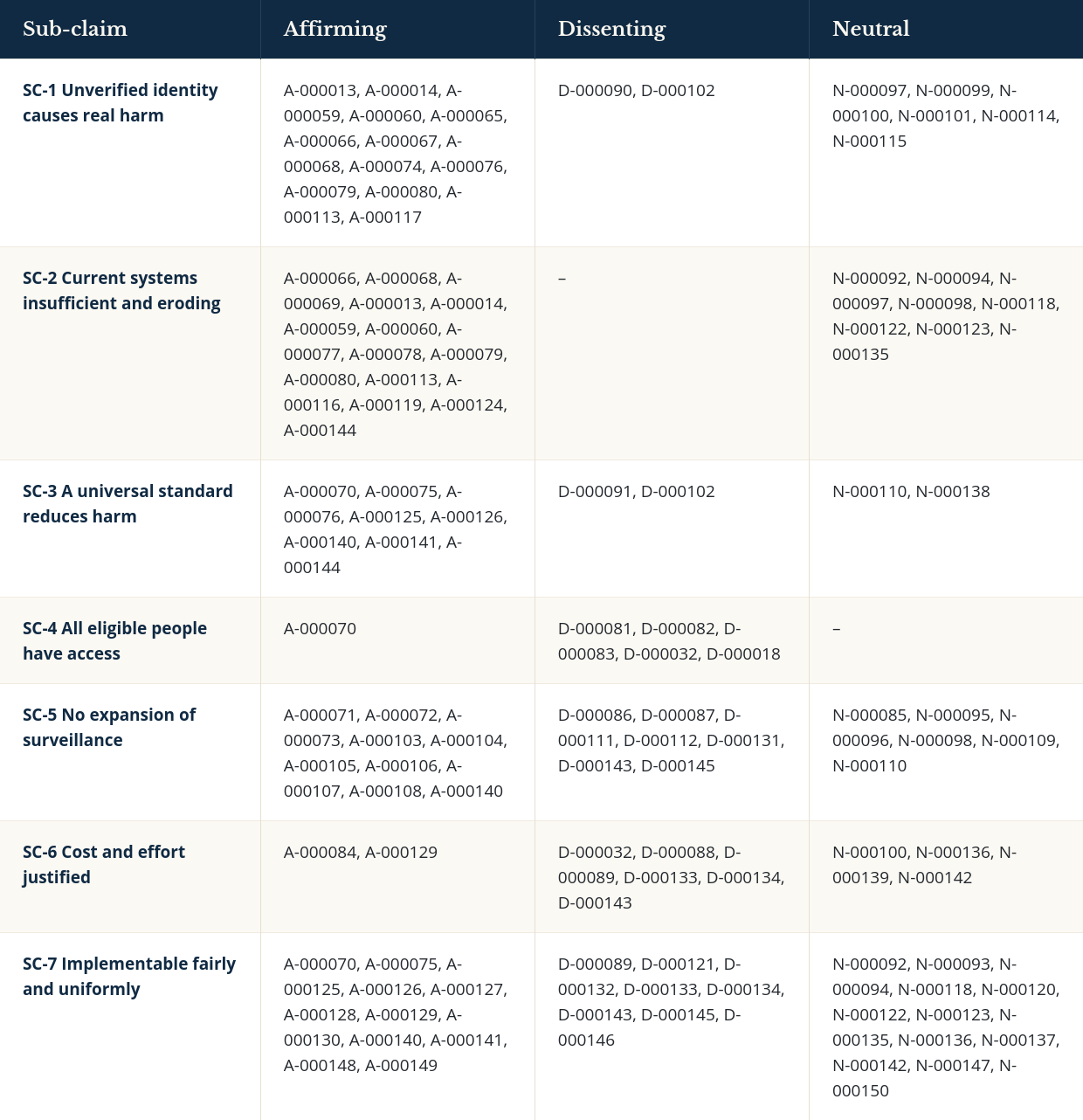
Sub-Claim Cross-Reference Matrix
Legend: Built from the sub-claim tags in the registry. Three dashes means no direct factual entry in that lane yet.
Known Gaps
This registry is a first tranche. The following gaps are open, and we state them rather than paper over them:
▪ SC-3 rests on capability, not on measured results. A-000075 and A-000076 establish that fingerprint-based national identification works and that name-based identification does not. What no source establishes is how much harm a universal credential would actually prevent, because no country comparable to the United States has adopted this exact requirement. D-000091 states the strongest objection.
▪ SC-6 rests on a single affirming fact. A-000084 prices one consequence of lacking a credential. Beyond it we have cost estimates from opponents and no independent or official cost study of a universal requirement. Official REAL ID implementation cost data from states would fill this.
▪ The cost of the overstay population is unmeasured. N-000100 records more than half a million overstay events in a single year. A number that size carries cost and risk. We have not found research estimating the financial or safety cost.
▪ Seizure counts are floors, not totals. A-000077 through A-000079 count counterfeit documents that were intercepted. Nothing in the record establishes what share of shipments is caught, so these figures set a minimum and cannot support a claim about the total volume in circulation.
▪ No current polling. As noted in Q1 | Meaning Section XI, the available national-identification polling is roughly two decades old and asked about carrying a card and about fingerprints. This claim does not requiring carrying a card, but does require biometric authentication of identity.
▪ Issuance-fraud prosecutions are not yet catalogued. Convictions for bribery and document fraud at motor-vehicle offices bear directly on SC-2 and are possibly underreported. This is reserved for a separate claim.
▪ Nobody knows the size of the population whose status is unrecorded. A-000113 explains why: It is estimated by subtraction, not counted. The official DHS figure and the leading independent estimate differ by three million,[N-000114, N-000115] and Congress has asked DHS to explain the divergence.[A-000116]
▪ Whether citizenship verification can be performed as a records check rather than a full adjudication. About half of American adults hold a passport, meaning their citizenship has already been determined [N-000136]. Whether confirming an existing record costs materially less than deciding a new claim is the question on which any national schedule depends, and we have found no study of it.
▪ Enhanced Driver’s License fraud findings. A-000127 and A-000128 supply issuance volumes, and N-000137 describes the federal audit process, but we have not located published error rates or fraud findings from the five issuing states.
Source Index
Alphabetical list of all sources cited in the registry. Sources are unnumbered; the permanent IDs belong to facts, not sources. Where a source is an advocacy organization or a policy institute with a stated position, that position is disclosed in the entry itself.
404 Media · American Civil Liberties Union · Bureau of Justice Statistics · Center for Strategic and International Studies · Associated Press · Brennan Center for Justice · Cato Institute · Center for Democracy and Technology · Charles Hamilton Houston Institute (Harvard Law School) · Congressional Research Service · Congress.gov · Driver’s Privacy Protection Act (18 U.S.C. § 2721) · Electronic Frontier Foundation · Electronic Privacy Information Center · Foreign Intelligence Surveillance Court · Federal Bureau of Investigation (IC3) · Federal Bureau of Investigation (CJIS) · Federal Reserve Bank of Boston · Federal Trade Commission · FinCEN (U.S. Treasury) · Government Accountability Office · Identity Theft Resource Center · Illinois State Police · Innocence Project · Javelin Strategy & Research · Maracich v. Spears (U.S. 2013) · National Law Center on Homelessness & Poverty · NBC News · New Jersey Monitor · New York State Inspector General · Office of the Director of National Intelligence · Oregon Secretary of State · REAL ID Act of 2005 · Reno v. Condon (U.S. 2000) · The 9/11 Commission Report · Transportation Security Administration · U.S. House Permanent Select Committee on Intelligence · U.S. Customs and Border Protection · U.S. Department of Homeland Security · University of Maryland Center for Democracy and Civic Engagement · Washington Post