

Government-issued photo ID and signature verification should be required at the time of voting.
Meaning ┃ Evidence ┃ Impact ┃Solution┃Summary
Q1 | Meaning
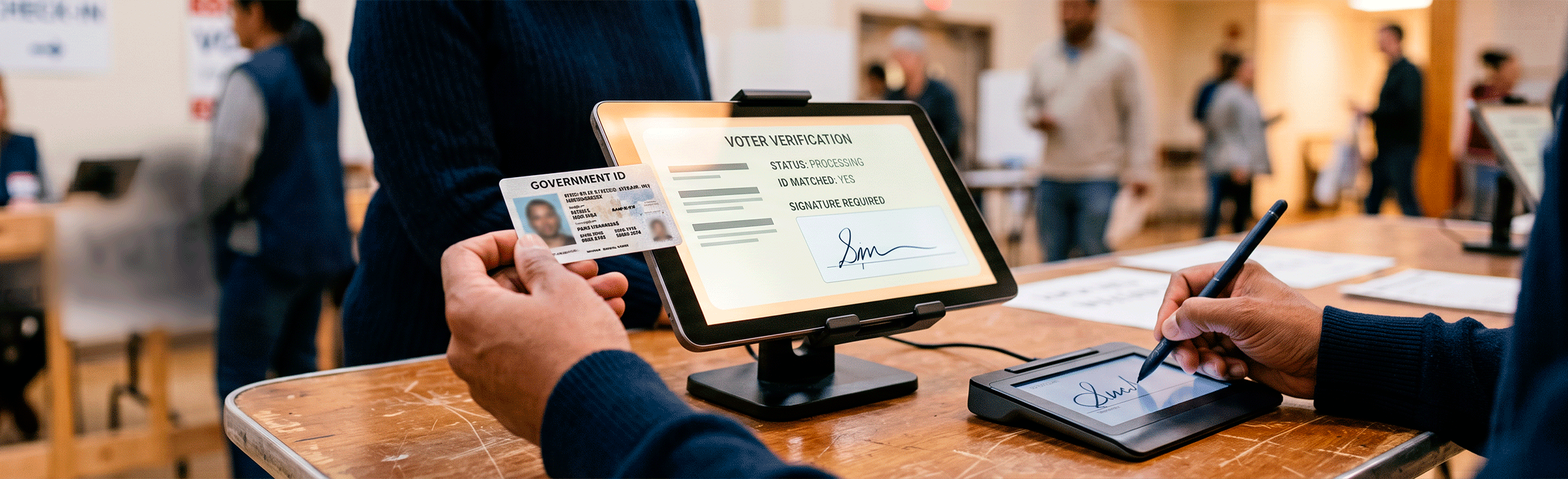
Before casting a ballot, every voter must (1) present a government-issued photo ID and (2) provide a signature that officials verify against the voter’s registration record. Two checks, at the moment of voting, in person and by mail. No state requires both today, so this claim is stricter than any current law. The Constitution assigns its enactment to state legislatures and Congress - not the president.
Q2 | Evidence
Every fact in this claim’s registry links to its end source - the statute, court record, database, or study itself - so readers can check us. Listing a fact does not mean we endorse it as true: We verify the lane and that each source states what we summarize. Our conclusions appear in Q3 and Q4.
Affirming: 15 facts, 31 source links.
Dissenting: 18 facts, 28 source links.
Neutral: 31 facts, 68 source links.
Total: 64 facts, 127 source links.
Q3 | Impact
Voter fraud is real, and courts have proven it. Confirmed fraud is also rare - the actual total is unknown. The danger is that in a close election, even a small amount can change the result.
The rules and processes for managing elections are different in every state, and technology is making it cheaper and easier to fake an identity every year. Even the official counts of how many Americans are registered disagree by tens of millions.
Large majorities of Americans in both parties call this requirement reasonable. The burden on honest voters is real but limited, and it can be managed: IDs can be free, mistakes can be fixed, and fair rules can be written - several states have already proven it. What remains falls on a small share of voters, and clear communication to them matters as much as the law itself.
When we started, two questions had no answers. Now they do:
What’s the cost of these programs? State records show the cost ranges from under one million to about twenty-five million dollars per state.
Does a strict ID law - by itself - increase public trust in elections? Studies conclude the answer is no. Thus, our proposed law requires the state to measure public trust after every election and publish the results.
Related Claims
This claim verifies identity at the moment of voting. Its full effect depends on companion claims, each receiving its own review:
Mail-in ballots must meet the same identity-verification standards as in-person voting (Claim #04-003-003).
Accurate voter rolls must be maintained (Claim #04-003-004).
All voters should be required to re-register to vote (Claim #04-003-005).
At all times, citizens must have a real, current, government-issued photo ID (Claim #01-004-001, Citizenship).
Q4 | Solution
The facts support this claim. It should become law - with the safeguards the evidence demands built into it:
A free photo ID for anyone who needs one;
No eligible voter turned away - a provisional ballot and a ten-day fix-it window;
Help with hidden costs for those in financial need;
Tribal IDs accepted as issued;
Direct communication to affected voters;
Signature safeguards with human review before any rejection;
The voter never pays - IDs are free, and support programs are funded by a small driver’s-license fee increase;
Built-in public reporting; and
Enactment only by state legislatures or Congress.
The full report contains our proposed Voter Verification Act - a complete draft for a law written in plain language, published for education and public discussion.
We provide this information, so citizens of good conscience may:
Understand this issue and a viable solution that serves the common good.
Have the facts to support polite discussion.
Consider applying this knowledge to engage effectively with their elected officials on this type of law.
Read the Full Report
Q1 | Meaning explains what the claim means. Q2 | Evidence holds all 64 facts with 127 live links. Q3 | Impact tests each of the six sub-claims. Q4 | Solution presents our proposed solution for the common good including a draft law, and the path forward.
Follow the links below - and judge the evidence for yourself.
Forward this to others.
If you are a Member, please comment.