

Government-issued photo ID and signature verification should be required at the time of voting.
Meaning ┃ Evidence ┃ Impact ┃Solution┃Summary
Why Is This Claim True?
Welcome!
This section is the factual registry for Claim #04-003-002. Its focus is facts, not arguments: Every entry states one verifiable fact in a single sentence, cites the end source - the statute, court record, database, study, or dataset where the fact terminates - and identifies the sub-claim(s) it bears on.
Arguments and interpretations remain in Q1 - Meaning (Sections IX–X) and Q3 - Impact, cited to the parties who make them; no opinion piece is cited here as if it were a fact.
The three lanes - Evidence is numbered as follows:
A-# | Affirming - facts a proponent would introduce to support this claim.
D-# | Dissenting - facts an opponent would introduce to discredit this claim.
N-# | Neutral- statutes, court holdings, official counts, polls, and facts both sides might introduce because it can be considered as both affirming and dissenting.
Evidence numbering
Evidence numbers are permanent in our system - once assigned, a number is never reused or reassigned. New facts take the next available number in their lane.
Sources can be repeatable - one source may support multiple entries in any lane.
Every fact must include a link to the source; a fact that cannot be traced to a primary source does not enter the registry.
Sub-claim tags use SC-1 through SC-6, matching Q1 - Meaning (full), Section II.
Known gap - Published polling from typically trustworthy sources test the photo-ID component only. We have not identified a poll testing this claim’s proposal to implement a two-factor process of identity confirmation.
Sub-claim key
SC-1 preventable fraud occurs, is likely undercounted, and could affect a close election.
SC-2 current safeguards are insufficient, and advances in digital technologies – including AI – are making them more so.
SC-3 the two-factor requirement will reduce ineligible voting.
SC-4 eligible voters would not be wrongly blocked.
SC-5 the cost and effort are justified.
SC-6 it can be implemented fairly and uniformly.
DISCLAIMER
Listing evidence in one of these three lanes does not mean we endorse it as true. We verify two things: The lane - Affirming, Dissenting, Neutral - and that each source states the fact we summarize. Upon close inspection, you may find the evidence claimed is strong, mixed, or weak.
It would imply bias for us to exclude perspectives that claim a reasonable factual basis, so we include the full breadth. However, in reality, studies rest on assumptions that can be biased; surveys are estimates, not full counts; and people on all sides of an issue do research with the intent to prove themselves right.
Follow the links and judge the evidence for yourself. We provide our conclusions in the Q3 - Impact and Q4 - Solution sections of an issue.
Affirming Facts (A)
A-1 | SC-1 - The Heritage Foundation’s Election Fraud Database documented 1,412 proven instances of election fraud as of January 2023, each ending in a criminal conviction, civil finding, or overturned election, and the database has continued to grow since.
Source: Heritage Election Fraud Database, electionfraud.heritage.org (Jan. 2023 update).
Links:
https://electionfraud.heritage.org/
Search: https://electionfraud.heritage.org/search
1,412-case count: https://www.heritage.org/election-integrity/commentary/election-fraud-database-tops-1400-cases
A-2 | SC-1, SC-2 - Heritage states its database is a sampling, not a comprehensive count, because it cannot include fraud that goes undetected or unprosecuted.
Source: “About the Election Fraud Database.”
Links: https://electionfraud.heritage.org/about
https://www.heritage.org/article/about-the-election-fraud-database
A-3 | SC-1 - The 2018 election in North Carolina’s 9th Congressional District was overturned and a new election ordered after a state investigation found an absentee-ballot trafficking operation run by political operative McCrae Dowless.
Source: North Carolina State Board of Elections order (Feb. 2019); Heritage database entry.
Links: Press release: https://www.ncsbe.gov/news/press-releases/2019/02/25/state-board-unanimously-orders-new-election-9th-congressional-district
Board order with findings: https://dl.ncsbe.gov/State_Board_Meeting_Docs/Congressional_District_9_Portal/Order_03132019.pdf
A-4 | SC-1, SC-3 - A Florida man forged his deceased wife’s signature on a mail-ballot request form and was charged with vote-by-mail fraud after election staff caught the fraud during a routine voter-roll check.
Source: Heritage database entry and underlying court record (2021).
Links: https://www.foxnews.com/us/florida-man-mail-in-ballot-dead-wife-voter-fraud-charge
A-5 | SC-2 - A Minnesota voter who cast a ballot without identification - because an acquaintance vouched for her identity – later pleaded guilty to registering in more than one precinct.
Source: Heritage database entry and Minnesota court record.
Link: https://electionfraud.heritage.org/case/201659
Item 3 on Minnesota SOS Elections & Voting, Register on Election Day webpage: https://www.sos.mn.gov/elections-voting/register-to-vote/register-on-election-day/
A-6 | SC-1 - The Supreme Court in Crawford found the risk of voter fraud “real” and stated that it “could affect the outcome of a close election.”
Source: Crawford v. Marion County Election Board, 553 U.S. 181 (2008).
Link: https://supreme.justia.com/cases/federal/us/553/181/
A-7 | SC-1 (historical) - A federal investigation of Chicago’s 1982 election estimated roughly 100,000 fraudulent ballots were cast, producing dozens of convictions.
Source: U.S. Attorney investigation records, cited in Heritage, “Voter Fraud.”
Link: Database case entry: https://electionfraud.heritage.org/case/200224
Full documentation with primary-source footnotes: https://www.heritage.org/election-integrity/report/where-theres-smoke-theres-fire-100000-stolen-votes-chicago
Overview (63 convictions): https://www.heritage.org/election-integrity/heritage-explains/voter-fraud
A-8 | SC-2 - A 2012 Pew study found approximately one in eight U.S. voter registrations was inaccurate, outdated, or duplicative, with about 1.8 million deceased individuals and nearly 3 million people registered in more than one state.
Source: Pew Center on the States, “Inaccurate, Costly, and Inefficient” (Feb. 2012).
A-9 | SC-2 - Voter registration relies on self-attestation of citizenship under penalty of perjury; election offices do not routinely verify citizenship against immigration databases at the point of registration.
Source: Bipartisan Policy Center, “Four Things to Know about Noncitizen Voting” (Feb. 2026).
Links: https://bipartisanpolicy.org/article/four-things-to-know-about-noncitizen-voting/
Illegal Immigration Reform and Immigrant Responsibility Act of 1996 - https://www.govinfo.gov/content/pkg/PLAW-104publ208/pdf/PLAW-104publ208.pdf
NVRA of 1993 (DOJ) - the law requiring the citizenship attestation under penalty of perjury: https://www.justice.gov/crt/national-voter-registration-act-1993-nvra
USCIS SAVE agency search tool (documents the 23 states with SAVE agreements for citizenship verification): https://www.uscis.gov/save/about-save/save-agency-search-tool?type_of_agency%5B%5D=5&benefit_category%5B%5D=97&benefit_category%5B%5D=98&items_per_page=10
NCSL, “Legislative Approaches to Ensuring Only Citizens Vote” (jury-dismissal data as a verification source): https://www.ncsl.org/elections-and-campaigns/legislative-approaches-to-ensuring-only-citizens-vote
A-10 | SC-4, SC-5 - The Crawford Court held that the inconvenience of obtaining Indiana’s free photo ID did not impose a substantial burden on most voters’ right to vote.
Source: Crawford v. Marion County Election Board, 553 U.S. 181 (2008).
Link: https://supreme.justia.com/cases/federal/us/553/181/
A-11 | SC-3, SC-6 - The bipartisan 2005 Commission on Federal Election Reform, co-chaired by former President Jimmy Carter and former Secretary of State James Baker, recommended a uniform photo-ID requirement paired with free IDs and affirmative state outreach.
Source: Carter-Baker Commission, “Building Confidence in U.S. Elections” (Sept. 2005).
Links: Original 2005 report (archived): https://capitalresearch.org/app/uploads/baker-carter-commission-2005-election-doc.pdf
Background: https://www.bakerinstitute.org/research/carter-baker-commission-16-years-later
A-12 | SC-6 - A 2016 Brennan Center report by Myrna Perez identified Rhode Island’s and Michigan’s voter ID laws as examples that increased security without disenfranchising eligible voters.
Source: Brennan Center, “Election Integrity: A Pro-Voter Agenda” (2016).
Links: https://www.brennancenter.org/our-work/policy-solutions/election-integrity-pro-voter-agenda (Can view, but PDF is behind a Scribd paywall.)
Referenced at: https://www.brennancenter.org/topics/voting-elections/voting-reform/voter-id
A-13 | SC-2 - In February 2024, journalists documented an underground service, OnlyFake, selling realistic fake-ID images for $15 – advertised as neural-network generated at up to 20,000 documents per day – including a fabricated California driver’s license, complete with a signature, that passed the automated identity check of a major cryptocurrency exchange.
Source: 404 Media, “Inside the Underground Site Where ‘Neural Networks’ Churn Out Fake IDs” (Feb. 2024), 404media.co. (Later forensic analysis questioned how much AI the service actually used; the cost, speed, and successful verification bypass are documented regardless.)
AI-claim: https://resistant.ai/blog/onlyfake-generative-ai-fraud
A-14 | SC-2 - The U.S. Treasury’s Financial Crimes Enforcement Network issued an alert in November 2024 reporting an increase in suspicious-activity filings describing deepfake media - including identity documents created or altered with generative AI – used to circumvent identity verification at financial institutions.
Source: FinCEN, Alert FIN-2024-Alert004 (Nov. 13, 2024), fincen.gov.
Links: Official alert PDF: https://www.fincen.gov/sites/default/files/shared/FinCEN-Alert-DeepFakes-Alert508FINAL.pdf
Press release: https://www.fincen.gov/news/news-releases/fincen-issues-alert-fraud-schemes-involving-deepfake-media-targeting-financial
A-15 | SC-4 - A nationwide analysis of voter files from 2008–2018 found strict ID laws had no significant negative effect on registration or turnout, overall or for any racial group.
Source: Cantoni & Pons, “Strict ID Laws Don’t Stop Voters” (NBER Working Paper 25522, later published in the Quarterly Journal of Economics)
Link: https://www.nber.org/system/files/working_papers/w25522/w25522.pdf.
Dissenting Facts (D)
D-1 | SC-1 - A Brennan Center review of the Heritage database found only 10 cases of in-person impersonation at the polls – the fraud type polling-place photo ID addresses – across the billions of votes the database’s time span covers.
Source: Brennan Center, “Heritage Fraud Database: An Assessment” (2017).
D-2 | SC-1 - The same review (D-1) found 41 cases of noncitizens registering, voting, or attempting to vote over roughly five decades.
Source: Brennan Center, “Heritage Fraud Database: An Assessment” (2017).
D-3 | SC-4 - More than 49 million American adults do not possess an unexpired driver’s license bearing their current name and address.
Source: Brennan Center / University of Maryland CDCE national survey (2024), brennancenter.org. (Survey estimate, n=2,386, weighted.)
Links: Figure stated at: https://www.brennancenter.org/topics/voting-elections/voting-reform/voter-id
Survey data (Brennan/UMD CDCE, June 2024): https://cdce.umd.edu/sites/cdce.umd.edu/files/pubs/Voter%20ID%202023%20survey%20Key%20Results%20June%202024%20updatev2.pdf
Weighted estimate from CDCE Survey data: https://cdce.umd.edu/feature/new-cdce-survey-shows-millions-lack-id-voter-id-laws-spread-more-states
D-4 | SC-4 - Approximately 11 percent of U.S. citizens in 2006 - about 21 million people - do not possess government-issued photo identification.
Source: Brennan Center survey, “Citizens Without Proof” (2006), cited in ACLU, “Oppose Voter ID Legislation – Fact Sheet.”
Links: https://www.brennancenter.org/our-work/research-reports/citizens-without-proof
2006 Figures confirmed in 2011 post: https://www.brennancenter.org/our-work/research-reports/citizens-without-proof-stands-strong
D-5 | SC-4 - The same survey found up to 25 percent of Black voting-age citizens lacked current government-issued photo ID, compared with about 8 percent of white voting-age citizens.
Source: Brennan Center, “Citizens Without Proof” (2006).
Links: New State Voting Laws: Barriers to the Ballot? (Sept. 28, 2011): https://brennancenter.org/analysis/new-state-voting-laws-barriers-ballot
2006 Figures confirmed in 2011 post: https://www.brennancenter.org/our-work/research-reports/citizens-without-proof-stands-strong
D-6 | SC-4 - A federal court found that 608,470 registered Texas voters - approximately 4.5 percent - lacked identification qualifying under the state’s 2013 photo-ID law.
Source: Veasey v. Perry, 71 F. Supp. 3d 627 (S.D. Tex. 2014).
Links: https://www.casemine.com/judgement/us/5914f18aadd7b0493497ba31
Finding recounted in GAO-14-634: https://www.gao.gov/assets/gao-14-634.pdf
D-7 | SC-4 - A Government Accountability Office study found turnout fell by an estimated two to three percentage points more in Kansas and Tennessee after those states adopted strict ID laws than in comparison states.
Source: GAO, “Issues Related to State Voter Identification Laws,” GAO-14-634 (Sept. 2014).
Link: Footnote 101, page 70: https://www.gao.gov/assets/gao-14-634.pdf
D-8 | SC-4 - Strict voter ID laws taking effect after Crawford reduced presidential-election turnout by more than 2.5 percentage points, while laws passed earlier had negligible effects.
Source: Academic study in Brennan Center research compilation, “Research on Voter ID.” (Confirm author/journal at link before freeze.)
Link: Compilation with links to each underlying study: https://www.brennancenter.org/our-work/research-reports/research-voter-id
D-9 | SC-4 - Stanford researchers found North Carolina’s strict ID law reduced turnout among voters lacking qualifying identification, and the effect persisted even after the law’s repeal.
Source: The Durable Differential Deterrent Effects of Strict Photo Identification Laws (Nov. 10, 2019). Published version of record (paywalled): Grimmer & Yoder, Political Science Research and Methods 10(3): 453–469 (2022), Cambridge Core
Link: Full text with methodology (Stanford Democracy & Polarization Lab): https://stanforddpl.org/papers/grimmer_yoder_2019_voterids/ or https://www.dropbox.com/scl/fi/0qvfoisdch7yai6zoz8tq/voter_id_deter.pdf?rlkey=tkap0c10igy0jykmbhf5107vc&e=1&dl=0
D-10 | SC-4 - Texas voters who could vote only through the court-ordered Reasonable Impediment Declaration – lacking qualifying ID – were disproportionately Black and Latino.
Source: Jones, Cross & Granato, “The Texas Voter ID Law and the 2016 Election” (Apr. 2017).
Link: Full study PDF: https://www.uh.edu/hobby/voterid2016/voterid2016.pdf
D-11 | SC-4 - Administrative-records research in Michigan found voters of color were more likely than white voters to arrive at the polls without qualifying identification.
Source: Academic study in Brennan compilation (2022).
Link: https://www.brennancenter.org/our-work/research-reports/research-voter-id
D-12 | SC-4 - In Rhode Island, turnout declined among citizens without driver’s licenses after the state’s ID law took effect, and minority citizens were considerably less likely to hold licenses.
Source: Administrative-records study in Brennan compilation (2022).
Link: https://www.brennancenter.org/our-work/research-reports/research-voter-id
D-13 | SC-4, SC-6 - North Dakota’s requirement of a physical street address on qualifying ID excludes many tribal-land residents whose IDs list PO boxes.
Source: Brennan Center, “The Impact of Voter Suppression on Communities of Color” (2022); related federal litigation.
Link: https://www.brennancenter.org/our-work/research-reports/impact-voter-suppression-communities-color
D-14 | SC-4, SC-5 - A Georgia federal court in October 2005 held the state’s photo-ID law an unconstitutional poll tax and undue burden, forcing the state to revise the law before a later version was upheld.
Source: Common Cause/Georgia v. Billups, 406 F. Supp. 2d 1326 (N.D. Ga. 2005).
Links: https://case-law.vlex.com/vid/commong-cause-georgia-v-892777754
Ruling documented at: https://www.brennancenter.org/our-work/research-reports/policy-brief-voter-identification
D-15 | SC-4 - Mail ballots cast by voters of color were rejected at higher rates than those of white voters in Georgia’s 2020 primary, with similar findings in Georgia’s and Florida’s 2018 general elections.
Source: Brennan Center research reports (2020); companion academic studies.
Link: https://www.brennancenter.org/our-work/research-reports/impact-voter-suppression-communities-color
D-16 | SC-4 - Signatures change with age, injury, stroke, and conditions such as Parkinson’s disease, and some states require a physician’s attestation before accepting a ballot whose signature no longer matches the file.
Source: Michael J. Fox Foundation, “Know Your Rights: Voting by Mail and Signature Verification” (Oct. 2020).
Link: https://www.michaeljfox.org/news/know-your-rights-voting-mail-and-signature-verification
D-17 | SC-4, SC-5 - A Harvard Law School institute report calculated that obtaining a nominally free voter ID typically costs the individual $75 to $175 in underlying documents, travel, and time - between 7 and 136 times the inflation-adjusted poll tax outlawed in 1964.
Source: Richard Sobel, “The High Cost of ‘Free’ Photo Voter Identification Cards,” Charles Hamilton Houston Institute, Harvard Law School (2014).
Link: https://hls.harvard.edu/today/free-voter-ids-costly-harvard-law-report-finds
D-18 | SC-5 - Peer-reviewed research has found no consistent relationship between strict photo-ID laws and voter confidence: No correlation between ID requirements and beliefs about fraud frequency (2008), no evidence that passing strict ID laws reduced belief in fraud (2016), and no significant effect on citizens’ belief that elections were fair (2019) - with the strongest measured driver of confidence being whether the voter’s preferred candidate won.
Source: Ansolabehere & Persily, Harvard Law Review 121 (2008); Stewart, Ansolabehere & Persily, Stanford Law Review 68 (2016); Cantoni & Pons, NBER Working Paper 25522.
Links: https://harvardlawreview.org/wp-content/uploads/2008/04/ansolabehere_persily.pdf
Stanford Law Review (2016): https://review.law.stanford.edu/wp-content/uploads/sites/3/2016/08/6_-_Persily_-_Stan._L._Rev.pdf
National study (NBER): https://www.nber.org/system/files/working_papers/w25522/w25522.pdf
Summary (MIT Election Lab): https://electionlab.mit.edu/research/voter-identification
Neutral Record (N)
N-1 | SC-2, SC-6 - As of October 2025, 36 states required identification at the polls – 24 of them photo ID, with exceptions – while 14 states generally required no ID on Election Day, and the 36 vary widely in accepted documents and no-ID procedures.
Source: Ballotpedia, “Voter identification laws by state” (Oct. 2025); Votebeat (Sept. 2025).
Links: https://ballotpedia.org/Voter_identification_laws_by_state
NCSL Voter ID report: https://www.ncsl.org/elections-and-campaigns/voter-id
N-2 | SC-2, SC-3 - Thirty-two states conduct signature verification on returned absentee/mail ballots.
Source: NCSL, “Table 14: How States Verify Voted Absentee/Mail Ballots” (2025).
Link: https://www.ncsl.org/elections-and-campaigns/table-14-how-states-verify-voted-absentee-mail-ballots
N-3 | SC-2 - Ten states, the District of Columbia, and the U.S. Virgin Islands verify only that the ballot envelope is signed, without comparing the signature to the file.
Source: NCSL, Table 14 (2025).
Link: https://www.ncsl.org/elections-and-campaigns/table-14-how-states-verify-voted-absentee-mail-ballots
N-4 | SC-2 - States without documentary ID requirements typically have voters sign a poll roster, mandate comparison of those signatures against registration records, and verbally confirm name and address.
Source: NCSL, “Voter Verification Without ID Documents” (2025).
Link: https://www.ncsl.org/elections-and-campaigns/voter-verification-without-id-documents
N-5 | SC-3, SC-6 - Some states verify mail ballots by alternative methods – a copy of an identification document, a witness signature, or notarization – rather than signature comparison.
Source: NCSL, Table 14 (2025).
Link: https://www.ncsl.org/elections-and-campaigns/table-14-how-states-verify-voted-absentee-mail-ballots
N-6 | SC-4, SC-6 - States with signature verification maintain cure processes allowing voters to correct a rejected signature, with windows and methods varying by state.
Source: NCSL, “Table 15: States with Signature Cure Processes” (2025).
Link: https://www.ncsl.org/elections-and-campaigns/table-15-states-with-signature-cure-processes
N-7 | SC-6 - In Crawford v. Marion County Election Board, the Supreme Court upheld Indiana’s strict photo-ID law in 2008, and the decision remains the controlling precedent for photo-ID statutes.
Source: 553 U.S. 181 (2008).
Link: https://supreme.justia.com/cases/federal/us/553/181/
N-8 | SC-4, SC-6 - Indiana’s law requires a government-issued photo ID whose name conforms to the registration record, provides free state IDs, and gives provisional voters ten days to present valid ID.
Source: Indiana Code; Indiana Secretary of State, in.gov/sos/elections.
Links: https://www.in.gov/sos/elections/voter-information/photo-id-law/
Statute confirmed in NCSL Voter ID report: https://www.ncsl.org/elections-and-campaigns/voter-id
Ten-day cure rule in Crawford: https://supreme.justia.com/cases/federal/us/553/181/
N-9 | SC-2 - The Help America Vote Act requires identification only from first-time voters who registered by mail, and accepts a current utility bill, bank statement, paycheck, or other government document as alternatives to photo ID.
Source: 52 U.S.C. § 21083 (HAVA § 303).
Link: https://www.law.cornell.edu/uscode/text/52/21083
N-10 | SC-6 - The Elections Clause assigns the times, places, and manner of congressional elections to state legislatures subject to congressional override, and Article II assigns the manner of appointing presidential electors to state legislatures.
Source: U.S. Const. art. I, § 4; art. II, § 1.
Links: https://constitution.congress.gov/browse/article-1/section-4/
https://constitution.congress.gov/browse/article-2/section-1/
N-11 | SC-5 - Gallup found in October 2024 that 84 percent of U.S. adults favored requiring photo identification at the voting place, including 98 percent of Republicans, 84 percent of independents, and 67 percent of Democrats.
Source: Gallup (Oct. 2024). (Survey estimate, weighted.)
Link: https://news.gallup.com/poll/652523/americans-endorse-early-voting-voter-verification.aspx
N-12 | SC-5 - Pew Research Center found in August 2025 that 83 percent of U.S. adults favored requiring all voters to show government-issued photo identification to vote.
Source: Pew Research Center (Aug. 2025). (Survey estimate, weighted.)
Link: Via fact brief linking the Pew data: https://gigafact.org/fact-briefs/voter-id-americans-support-wisconsin-poll-photo-identification/
Corroborating coverage: https://www.nbcnews.com/politics/congress/americans-support-photo-id-vote-democrats-oppose-save-america-act-rcna259549
N-13 | SC-5 - Rasmussen Reports found in January 2025 that 77 percent of likely voters called requiring photo ID to vote a reasonable election-integrity measure.
Source: Rasmussen Reports (Jan. 2025). (Survey estimate, n=1,229 likely voters, ±3 points, weighted.)
Linked from: https://gigafact.org/fact-briefs/voter-id-americans-support-wisconsin-poll-photo-identification/
N-14 | SC-2 - Federal law since 1996 has explicitly prohibited noncitizens from voting in federal elections, with penalties including imprisonment and deportation.
Source: Illegal Immigration Reform and Immigrant Responsibility Act of 1996; 18 U.S.C. § 611.
Links: https://www.law.cornell.edu/uscode/text/18/611
Official public law PDF, IIRIRA, Pub. L. 104-208 (fine and up to one year imprisonment): https://www.govinfo.gov/content/pkg/PLAW-104publ208/pdf/PLAW-104publ208.pdf
8 U.S.C. § 1182 - deportability/inadmissibility for unlawful voting and for falsely claiming citizenship: https://www.law.cornell.edu/uscode/text/8/1182
N-15 | SC-2 - No state allows noncitizens to vote in statewide elections; the District of Columbia and certain municipalities in California, Maryland, and Vermont allow noncitizen voting in some local elections.
Source: Ballotpedia, “Laws permitting noncitizens to vote in the United States” (Mar. 2026); Bipartisan Policy Center (Feb. 2026).
Links: https://ballotpedia.org/Laws_permitting_noncitizens_to_vote_in_the_United_States
https://bipartisanpolicy.org/article/four-things-to-know-about-noncitizen-voting/
San Francisco school board voting: https://sfstandard.com/2023/08/09/noncitizen-voting-school-board-san-francisco/
Oakland Measure S (2022): https://ballotpedia.org/Oakland,_California,_Measure_S,_Noncitizen_Residents_Voting_Measure_(November_2022) - with implementation status: https://oaklandside.org/2024/11/01/measure-s-noncitizen-voting-oakland-school-board-election/
Maryland/Vermont municipalities (anchor-specific version of your existing Ballotpedia link): https://ballotpedia.org/Laws_permitting_noncitizens_to_vote_in_the_United_States#Details_about_noncitizen_voting_in_local_elections
DC Law 24-242 (the actual statute): https://code.dccouncil.gov/us/dc/council/laws/24-242
Separate-ballot safeguard in Maryland cities (NPR): https://www.npr.org/local/305/2022/11/09/1135568975/it-feels-very-welcoming-non-citizen-immigrants-on-voting-in-takoma-park
N-16 | SC-6 - New York City’s 2021 law extending local voting to noncitizens was struck down under the state constitution, a ruling the New York Court of Appeals affirmed 6–1 in March 2025.
Source: New York Court of Appeals decision (Mar. 2025); FindLaw (Mar. 2026).
Links: Fossella v. Adams (N.Y. Ct. App., Mar. 20, 2025) documented at: https://ballotpedia.org/Laws_permitting_noncitizens_to_vote_in_the_United_States
https://www.findlaw.com/voting/my-voting-guide/can-noncitizens-vote-in-the-united-states.html
The 2022 trial-court ruling that started it (CNN): https://www.cnn.com/2022/06/27/politics/noncitizen-voting-new-york/index.html - your entry’s fact is the 2025 Court of Appeals affirmance; this documents the lower-court stage.
N-17 | SC-5 - From 2018 through 2025, voters approved all 15 statewide constitutional amendments strengthening citizenship requirements for voting, averaging 73 percent support, and six more citizenship measures are on 2026 ballots, including Los Angeles’s November 2026 measure on local noncitizen voting.
Source: Ballotpedia News (July 2026); Spectrum News (June 2026).
LA measure: https://spectrumlocalnews.com/ca/california/politics/2026/06/19/los-angeles-non-citizen-voting
N-18 | SC-6 - The SAVE Act, requiring documentary proof of citizenship at voter registration, passed the U.S. House and was pending in the Senate as of early 2026.
Source: Congress.gov, H.R. 22 (119th Congress).
Link: https://www.congress.gov/bill/119th-congress/house-bill/22
N-19 | SC-4, SC-6 - A March 2025 executive order directed proof of citizenship on the federal registration form, listing passports and citizenship-designating IDs but not birth certificates as acceptable, while roughly half of Americans hold passports; nineteen states sued, courts blocked its major provisions during 2025, and in January 2026 a federal judge permanently blocked the order, finding the president lacks authority to unilaterally alter election procedures.
Source: Executive Order (Mar. 25, 2025); NBC News (Mar. 2025); TIME (Aug. 2025); NBC News (Feb. 2026); U.S. State Department passport data.
Links: Official text: https://www.federalregister.gov/documents/2025/03/28/2025-05523/preserving-and-protecting-the-integrity-of-american-elections
Litigation status (CRS): https://www.congress.gov/crs-product/LSB11368
Litigation history (19 states, 2025 injunctions): https://time.com/7313626/trump-voter-id-executive-order/
January 2026 permanent block: https://www.nbcnews.com/politics/elections/trump-vows-voter-id-requirements-midterms-rcna259018
N-20 | SC-1, SC-2 - Georgia’s October 2024 citizenship audit of 8.2 million registered voters identified 20 noncitizen registrations, of whom nine had voted, most before the state’s 2012 verification upgrade.
Source: Georgia Secretary of State announcement (Oct. 2024), via Bipartisan Policy Center.
Links: https://bipartisanpolicy.org/article/four-things-to-know-about-noncitizen-voting/
The Georgia Recorder report of Raffensperger’s announcement, with the 20-registered/9-voted figures: https://georgiarecorder.com/briefs/georgia-gop-secretary-of-state-reports-audit-found-20-noncitizens-registered-to-vote-out-of-8-2m/
N-21 | SC-1, SC-2 - Utah’s 2025–26 review of more than two million voter registrations found one confirmed noncitizen registration and zero noncitizen votes.
Source: Utah state review (Jan. 2026), via Bipartisan Policy Center.
Links: State of Utah Citizenship Review Process, January 22, 2026: https://drive.google.com/file/d/1CNkU8qcrIQ-vYUaE4OyCBqydk5toZAR9/view
https://bipartisanpolicy.org/article/four-things-to-know-about-noncitizen-voting/
https://www.democracydocket.com/news-alerts/utah-reviewed-its-voter-rolls-for-noncitizens/
N-22 | SC-1 - A Bipartisan Policy Center review of the Heritage database identified 77 instances of noncitizens successfully casting ballots between 1999 and 2023.
Source: Bipartisan Policy Center, “Four Things to Know about Noncitizen Voting” (Feb. 2026).
Links: https://bipartisanpolicy.org/article/four-things-to-know-about-noncitizen-voting/
77 noncitizen voting instances: https://www.heritage.org/voterfraud/search?combine=citizen&state=All&year=&case_type=All&fraud_type=All - NOTE: The article’s footnote 2 gives BPC’s full methodology (scraped Oct. 11, 2024; queries “citizen” and “alien”; manual review to 77)
N-23 | SC-1, SC-2 - Ohio’s Secretary of State flagged 521 potential noncitizen voting cases between 2019 and September 2023, but a journalistic review found only one resulted in a voter-fraud charge, with most flags traced to clerical errors and DMV lag in recording naturalizations.
Source: Ohio Capital Journal, “Ohio Sec. of State LaRose flagged more than 520 cases of noncitizen voter fraud. Only one was legit” (Sept. 27, 2023).
N-24 | SC-6 - President Trump announced in August 2025 that he would sign an executive order requiring voter ID in all elections nationwide, and renewed the vow in February 2026 - “whether approved by Congress or not” - after the SAVE America Act passed the House; as of this writing, no such order has issued, and a federal court struck down the voter-ID portions of his earlier March 2025 election order as beyond presidential authority.
Source: Fox News (Aug. 30, 2025); Votebeat news analysis (Sept. 8, 2025); NBC News (Feb. 13, 2026).
Links: https://www.foxnews.com/politics/trump-says-he-require-voter-id-executive-order
Implementation-complexity analysis: https://www.votebeat.org/2025/09/08/trump-executive-order-voter-id-requirement-emergency-power/
February renewal: https://www.nbcnews.com/politics/elections/trump-vows-voter-id-requirements-midterms-rcna259018
N-25 | SC-3, SC-6 - Election officials verifying signatures commonly compare the ballot signature against multiple signatures on file - the registration record, prior ballot envelopes, motor-vehicle transactions - so they can account for the evolution of a voter’s handwriting, and best practice pairs verification with prompt notification and a cure process when a signature is rejected.
Source: National Vote at Home Institute, “Increasing Signature Verification.”
Links: https://voteathome.org/signature-verification/
Stanford Law School report: https://voteathome.org/portfolio/stanford-law-school-report-signature-verification-and-mail-ballots-guaranteeing-access-while-preserving-integrity/
N-26 | SC-1, SC-2 - A software flaw in New Jersey’s motor-vehicle system registered roughly 6,600 noncitizens to vote between June 2023 and June 2024 - enrolling applicants even though they answered “no” to the citizenship question - and a preliminary state review found about 400 cast ballots in 2023-2024 elections, with no evidence any race was swayed; the error took a year to fix, was not disclosed until July 2026, and those registered remained on the rolls up to three years before removal began.
Source: Gov. Sherrill announcement (July 21, 2026); NBC News; New Jersey Monitor; WHYY; CBS New York (July 2026). NOTE: Responsibility is contested - the vendor says the state Division of Elections is responsible for verifying eligibility - and a DOJ investigation is open; figures may change.
Governor’s press conference: https://newjerseymonitor.com/2026/07/21/governor-software-error-non-citizens-register-vote/
How the glitch occurred: https://whyy.org/articles/new-jersey-motor-vehicle-commission-glitch-noncitizens-registered-vote/
Vendor dispute and DOJ demand: https://www.cbsnews.com/newyork/news/new-jersey-noncitizen-voting-mikie-sherrill-department-of-justice/
N-27 | SC-1, SC-2 - Oregon’s motor-voter system mistakenly registered more than 1,600 people who had not provided proof of citizenship, an error discovered in 2024 and traced to DMV staff mis-selecting document types; state reviews found about 17 of them had voting histories - several legally, having become citizens before voting - with roughly 9 potentially ineligible, and the governor paused automatic registration until an independent audit produced new rules in 2026.
Source: Oregon Secretary of State newsroom (Sept. 2024); AP (Sept. 30, 2024); KOIN (Feb. 2026).
Audit and 2026 rule changes: https://www.koin.com/news/oregon/oregon-motor-voter-program-updated-after-1k-people-mistakenly-registered-to-vote/
N-28 | SC-5 - Indiana’s photo-ID law cost about $12.2 million over its first four years - including more than $1.3 million to produce 168,000+ free IDs, nearly $2.2 million in lost card-fee revenue, and $2.2 million in voter education - roughly equal to the state Elections Division’s entire annual budget at the time.
Source: Brennan Center, “The Cost of Voter ID Laws: What the Courts Say” (2011), citing Indiana state estimates; Keystone Research Center (2011).
Keystone Research Center analysis: https://keystoneresearch.org/wp-content/uploads/Cost-of-Voter-ID-Law-to-PA.pdf
N-29 | SC-5 - Official fiscal notes and independent estimates for other states’ voter-ID laws ranged from about $720,000 plus $260,000 recurring (South Carolina) to $5.7 million (Wisconsin), $6 million in year one plus $4 million annually (Missouri), and $18-25 million over three years (North Carolina), with voter-education spending varying from $0.15 to $1.37 per voter.
Source: Brennan Center cost memo and state updates (2011); Wisconsin Legislative Fiscal Bureau.
Links: https://www.brennancenter.org/our-work/analysis-opinion/update-voter-id-costs-states
Cost memo (PDF): https://www.brennancenter.org/sites/default/files/legacy/Democracy/Voter%20ID%20Cost%20Memo%20FINAL.pdf
Education-cost figures: https://www.brennancenter.org/our-work/analysis-opinion/truth-about-voter-id-costs
N-30 | SC-5 - The Supreme Court has described voting as “a fundamental political right, because preservative of all rights.”
Source: Yick Wo v. Hopkins, 118 U.S. 356, 370 (1886).
Link: https://supreme.justia.com/cases/federal/us/118/356/
N-31 | SC-2 - The federal government’s two official counts of registered voters diverge by tens of millions: The Census Bureau’s 2024 survey reports about 174 million Americans saying they are registered (73.6% of voting-age citizens), while the Election Assistance Commission’s 2024 administrative survey of state rolls counts more than 211 million active registered voters (86.6%) - a gap driven by how “registered” is defined and by names states have not yet pruned as duplicate, outdated, or ineligible.
Source: U.S. Census Bureau, “Voting and Registration in the Election of November 2024” (P20-587, Apr. 2025); U.S. Election Assistance Commission, 2024 EAVS Comprehensive Report (June 30, 2025).
Links: https://www.census.gov/data/tables/time-series/demo/voting-and-registration/p20-587.html
Full EAVS report (PDF): https://www.eac.gov/sites/default/files/2025-07/2024_EAVS_Report_508.pdf
EAC report hub: https://www.eac.gov/research-and-data/studies-and-reports
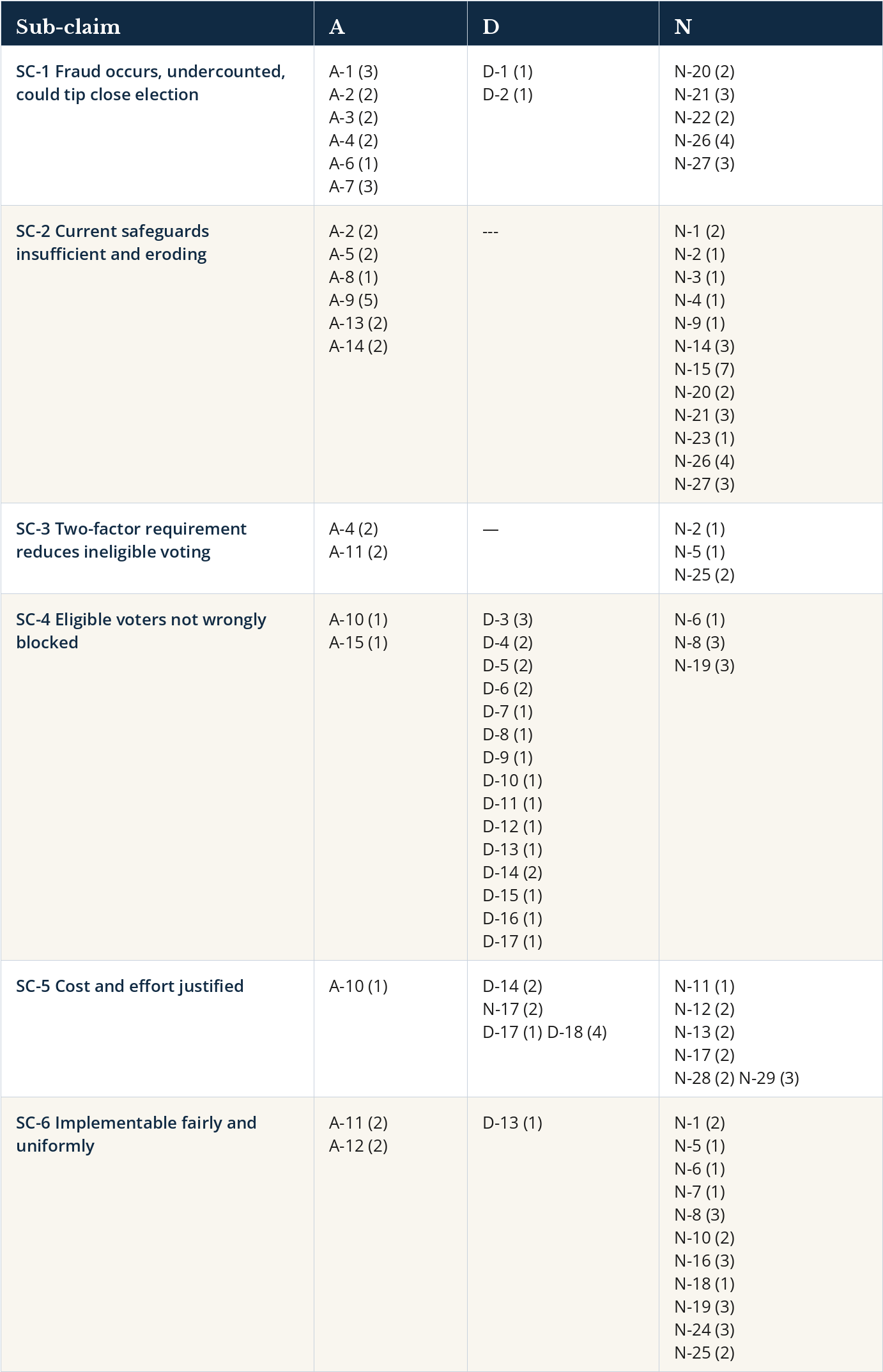
Sub-Claim Cross-Reference Matrix
Legend:
Built from the sub-claim tags in the registry.
Three dashes means no direct factual entry in that lane, although indirect facts may be presented in other sub-claims.
Number in parenthesis indicates number of links for that Evidence number. For instance, A-1 (3) means three links to facts support A-1.
Source Index
Alphabetical list of all sources cited in the registry. Sources are unnumbered; the permanent IDs belong to facts, not sources.
404 Media · ACLU · Ballotpedia / Ballotpedia News · Bipartisan Policy Center · Brennan Center for Justice · Carter-Baker Commission · Charles Hamilton Houston Institute (Harvard Law School) · Congress.gov · Common Cause/Georgia v. Billups (N.D. Ga. 2005) · Crawford v. Marion County Election Board (U.S. 2008) · FinCEN (U.S. Treasury) · Gallup · GAO · Georgia Secretary of State · Harvard Law Review · Heritage Foundation Election Fraud Database · Indiana Code / Indiana Secretary of State · Jones, Cross & Granato (Univ. of Houston) · Keystone Research Center · Michael J. Fox Foundation · MIT Election Lab · NBC News · NBER (Cantoni & Pons) · NCSL · North Carolina State Board of Elections · Pew Center on the States · Pew Research Center · Rasmussen Reports · Spectrum News · Stanford Law Review · U.S. Code (18 U.S.C. § 611; 52 U.S.C. § 21083) · U.S. Constitution · Utah state election review · Veasey v. Perry (S.D. Tex. 2014) · Votebeat · White House (Executive Order, Mar. 2025) · Wisconsin Legislative Fiscal Bureau