
Read the summary of this post here
What if all federal judges consistently applied our Constitution and the law faithfully - rather than rewriting or creating law aligned with their personal or political preferences?
This is the third in our series of Commoners’ Corner posts exploring the vision of Simple Liberty - and the last of three examining the branches of government our Founders designed to serve us, not rule us.
In Posts #1 and #2, we examined the Executive and Legislative branches. The pattern was the same in both: Institutions brilliantly designed for the common good, now too often corrupted for personal power, profit, and ruling class advantage - across both parties, spanning decades, on our watch as citizens.
This is not a left problem or a right problem. Both parties have appointed judges who exceeded their authority, manipulated the confirmation process, and complained about overreach only when a ruling went the other way.
The Judicial branch is no different, because power can corrupt.
But it carries one hard difference: Presidents can be voted out and members of Congress defeated at the polls, while our Constitution gives federal judges their seats for life.
Hamilton called the judiciary the weakest branch. Jefferson feared it would become too strong. Today, Jefferson’s worry looks closer to the truth.
Remember, too, that the judiciary is not just the Supreme Court. It is a three-tier system - district courts, then circuit courts of appeals, and then rising to the Supreme Court - and the problems exist at every level, often worse in the lower courts where there is less scrutiny.
So, we must address a serious challenge:
How do we hold the Supreme Court - and every federal judge - accountable for applying the Constitution rather than twisting it for preference, profit, or power - and have that accountability itself be pure?
Most solutions proposed to date could simply transfer the corruption to a new oversight group.
Here is a fresh way to see it. We would never run any serious organization the way we run our courts. I have coached leaders for the past twenty years and my career spans decades before that. A healthy organization operates on four management disciplines, which are how you:
- Hire the right people
- Manage your team
- Develop their strengths
- Hold them accountable
For the most powerful lifetime positions in America, we do almost none of it - no real pipeline, virtually no management, little ongoing intellectual development, and no accountability - especially with the Supreme Court.
Our Founders knew people are not angels - that we are moved by passion and self-interest. So, they designed a government that channels those forces, structuring decisions so reason has the best chance of prevailing.
How would our Founders design each stage to be fair and nonpartisan - to limit the pull of human passion while giving reason the best chance to win?
The answer is to make each stage deliberately balanced - just as our Executive, Legislative, and Judicial branches balance each other to prevent tyranny. That balance holds only when each branch stays within the limits our Constitution sets.
The triumvirate standard for the Judicial branch: Judges must consistently apply the Constitution and the law, remain fit to serve, and keep their integrity.
No party or individual should have the opportunity to control them. And nearly all of this structure can be established by ordinary legislation - no constitutional amendment required.
Here are seven What If questions about our federal courts. These are not radical demands. They are reasonable standards for an institution our republic depends upon to apply justice faithfully, transparently, and without fear or favor.
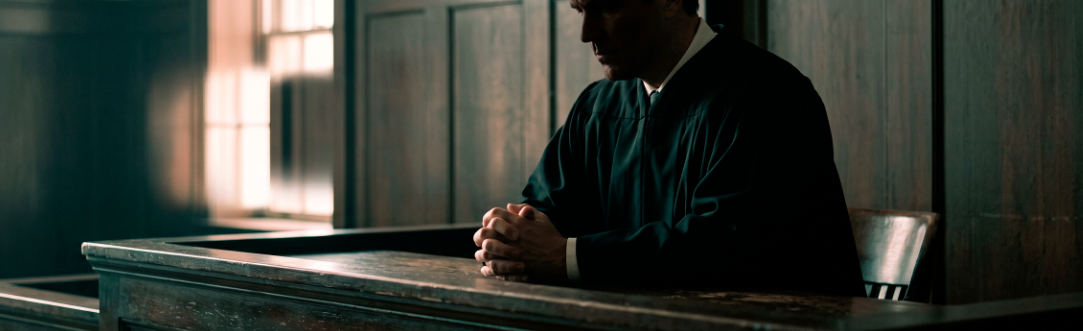
#1 - WHAT IF… Character Actually Mattered?
The pattern should be familiar by now. We asked this same question of our presidents in Post #1 and our Congress in Post #2. We ask it again because the answer is the same:
Without good character at the foundation, every structural reform is a sandcastle. Rules only constrain bad actors until they find ways around them - character constrains people from within.
Is it any wonder that public confidence in our courts recently fell to a record low?
What if we confirmed only federal judges of proven good character - fully committed to faithfully applying the Constitution and the law, regardless of who appointed them or which party would prefer a different outcome?
A judge of good character understands that the robe is not a license. It is a responsibility. The moment a judge reasons backward from a preferred outcome to a legal justification - or seeks to justify their foregone conclusion - they have stopped being a judge and become a politician in a robe.
We already have high-integrity judges at every level, appointed by both parties - not perfect, but principled, applying the Constitution and the law as written. We are grateful for them. They are the standard - what we should demand of every nominee and every sitting judge.
ENDNOTES: 1-3
#2 - WHAT IF… We Developed Principled Judges Before They Reached the Bench?
Have you ever considered how someone becomes a federal judge?
The answer is concerning. The Constitution requires nothing - no minimum age, no legal experience, not even a law degree. In practice, candidates emerge through senatorial relationships and presidential politics, vetted mostly for ideology and loyalty.
There is no nonpartisan system that develops, trains, and tests candidates on how faithfully they apply the Constitution and the law. We fill the most powerful lifetime positions in America with less structure than most businesses use to hire an entry-level receptionist.
This matters because of sheer scale. There are more than 870 federal judgeships, and a single presidential term now fills over 200 of them. These judges rule for life.
What if Congress and the Judicial branch were assigned a shared responsibility to build a nonpartisan pipeline - a training and mentoring path for those who aspire to the federal bench?
Clear, merit-based standards. Rigorous grounding in constitutional law and our founding documents. A close look at how a candidate has actually applied the law. Experienced mentors. Those who meet the criteria, stay vetted, and remain committed would form a deep, principled pool.
The President would still nominate and the Senate still confirm, exactly as the Constitution requires - but they would be choosing from a pool of candidates already proven on their fidelity to the Constitution rather than loyalty to a party or personal bias. And reaching outside that proven pool would invite public pressure to explain why.
Some of the infrastructure to support this already exists: The judiciary runs an education arm, and several states screen judicial candidates through nonpartisan nominating commissions.
We can take the strengths of these programs, and other processes like them, to build a rigorous pipeline that develops judges faithful to the law rather than to a party or personal bias
ENDNOTES: 4-6
#3 - WHAT IF… Judges Kept Growing in Their Craft?
Getting the right people onto the bench is only the beginning. How are federal judges developed over a career that can last thirty or forty years?
Today, largely on their own. The judiciary offers education, but little of it is required, and nothing systematically keeps a judge sharp on the single most important question - are they applying the law, or quietly rewriting it?
What if every federal judge, including every Supreme Court justice, took part in regular, nonpartisan peer formation?
Picture working groups of judges - different courts, different levels of experience - meeting to study real cases and ask the hard question together: Was the law applied as written, or interpreted to reach a preferred result.
This is for sharpening the mind - “iron sharpens iron” - not punishment. Open discussion to expand knowledge, deepen discernment, and strengthen a shared commitment to applying our Constitution and laws. This is how every serious profession keeps its people growing. It threatens no one’s independence, because it corrects through learning, not consequences.
Several states already evaluate judicial performance through nonpartisan review; the federal courts could build an educational version focused squarely on faithful application of the law.
ENDNOTES: 7-9
#4 - WHAT IF… Judges Applied the Law Instead of Making Law?
This is the standard every judge is measured against - and the one most often broken.
Our Constitution gives each branch a distinct role. The Legislative - Congress - makes the law. The Judicial - our courts - applies it. The Executive - the president - enforces it.
Interpreting and applying the law as written is the court’s job. Rewriting it is not. When courts invent rights the Constitution never granted - or ignore rights it plainly protects - they are unconstitutionally revising our laws.
The cause may be bias, incompetence, or cowardice - the result is the same: Self-governance is violated.
The remedy is not a different ideology on the bench. It is a restored commitment to the actual job - asking not what the law should say, but what it does say, and applying law in the context in which it was written.
Where the law is silent or ambiguous, the answer is not judicial invention. It is legislative action or, in the rare case our Constitution needs updating, the amendment process our Founders wisely established.
How is this standard enforced without threatening a judge’s independence?
Not by punishing unpopular rulings - that cure is more dangerous than the disease. It is enforced the way it always has been, only better: Through higher courts that correct errors on appeal, through the transparency that lets citizens see a judge’s reasoning, and - most powerfully - by selecting and developing judges who are faithful to the text in the first place.
The courts cannot be a shortcut around the people’s elected representatives and established constitutional process.
ENDNOTES: 10-12

#5 - WHAT IF… Every Judge Were Held Accountable - and Fit to Serve?
Here is the question that exposes another deep gap: When a federal judge crosses an ethical line - or can no longer do the job - what actually happens?
For most of the judiciary, very little. For the Supreme Court, almost nothing at all.
A binding ethics code. Until 2023, the Supreme Court operated with no formal ethics code whatsoever. The one it finally adopted is voluntary, self-policed, and carries no enforcement - no one outside the Court can even file a complaint.
Lower federal judges are bound by a code, but it is enforced by other judges with limited consequences.
Citizens need a single, binding, enforceable ethics code applied to every federal judge, including every justice - covering conflicts of interest, mandatory and reviewable recusal, and complete, accessible financial disclosure.
Fitness to serve. Lifetime tenure assumes a lifetime of capability. But judges, like all of us, can decline - physically or mentally. For the lower courts there is a limited process to address a judge who can no longer serve. For the Supreme Court there is none but impeachment.
Citizens need every judge, at every level, subject to a clear, nonpartisan standard of fitness - physical and mental - applied with dignity and evidence, not politics.
A real process. Today, when there is a concern that a judge is violating the boundaries of their role, there is no process to investigate a valid claim.
Here is a draft outline of a better process to develop, debate in Congress, and establish as law:
First, anyone may bring a concern to a nonpartisan review body that covers every federal judge, including Supreme Court justices.
Second, the body screens out the frivolous and the merely political.
Third, a neutral panel investigates the facts - including a fitness evaluation when there is evidence to support the concern.
Fourth, a decision is made. This is the hardest step, because the decision must rest on facts - reached without bias, under the same standards for every judge, and within a reasonable time.
Part of the decision is consequences when the facts clearly show misconduct or incapacity, unfair, consistent proportion to the situation: Private reprimand with or without counseling, public reprimand, removal from cases, or referral to Congress for impeachment in the gravest cases.
Notice the guardrail: This process judges conduct, ethics, and fitness - never the content of a ruling. A judge is never punished for an unpopular decision, only for genuine misconduct or incapacity.
This standard keeps accountability from becoming a partisan weapon - the very corruption transfer we must avoid. Accountability and independence are not enemies. A strong judiciary needs both.
ENDNOTES: 13-15
#6 - WHAT IF… Congress Fulfilled Its Oversight Role Without Political Bias?
None of this works without the one branch the Constitution already empowered to act. The Senate confirms every federal judge, and Congress writes the laws the courts apply.
Unfortunately, in recent decades, Congress has focused more on applying political party priorities to the judiciary than on fulfilling its responsibility to make certain our judicial branch is operating within the boundaries of our Constitution.
The confirmation process is political theater rather than public service. Both parties share the blame. One side has blocked nominees from hearings or votes for years, leaving courts understaffed. The other has turned hearings into ideological auditions, demanding signals on hot-button cases.
Both treat the judiciary as a prize to be won rather than an institution to be staffed with principled jurists - and ordinary citizens pay the price. There are dozens of vacancies today, and in some districts civil cases take three to four years to reach trial.
Justice delayed is justice denied, and it falls hardest on Americans who cannot afford to wait.
Let’s consider a new standard: First, the Senate must provide every nominee a timely hearing and vote within 90 days - regardless of which party holds power.
Second, hearings are solely focused on qualifications, judicial philosophy, and demonstrated character - not extracting political promises.
Congress also has the authority - and the duty - to clarify by legislation where courts have strayed beyond their constitutional boundaries. This is not an attack on judicial independence. It is the checks and balances our Founders built, used as intended.
The judiciary serves the people. Because it is staffed by imperfect humans, it needs oversight - fair, nonpartisan, and faithful to our Constitution.
ENDNOTES: 16-18
#7 - WHAT IF… The Courts Operated in the Open?
Accountability is impossible in the dark. A citizen cannot judge whether a court applied the law or rewrote it when the court’s work is hidden, rushed, or written to be understood only by lawyers.
Transparency is the condition that makes accountability - and every other reform - possible.
Clear opinions. Judicial opinions must be written so the citizens they affect can understand them. The law belongs to the people, not to the legal profession.
This does not mean oversimplifying hard questions - it means writing with the citizen in mind, not the law review. Even lawyers, studies find, understand and prefer plain language over legalese.
The shadow docket. The Supreme Court increasingly decides significant matters through emergency orders - without full briefing, argument, or explanation.
Major decisions that affect millions deserve the full, open, deliberative process the Court was built to provide. Emergency procedures should be reserved for genuine emergencies, not used as a shortcut around the transparency the public is owed.
Nationwide injunctions and forum shopping. Today, a single district judge can freeze federal policy for the entire country - and lawyers have learned to steer cases to the judge most likely to give them what they want.
One judge in one district should not govern three hundred million Americans. This power should be examined and constrained by legislation to end the forum-shopping game that both parties have exploited.
Taken together, these reforms make the courts transparent, and transparency makes accountability real - without compromising the constitutional judicial independence that protects us all.
ENDNOTES: 19-21
The Mountain Ahead
Making these changes will be challenging, but not impossible.
American citizens have never voted for a single federal judge - and never will - although in many states we vote for state and local judges. We do, however, choose the President who nominates them, and the senators who confirm them.
This is why every vote counts. Too many of us are not voting - or voting based on emotion rather than facts - and every uncast or miscast vote forfeits power to the powerful. In 2024, roughly 89 million eligible Americans did not vote - more than voted for either candidate.
Self-governance is not a spectator sport.
The cost is small - a little of our time, attention, and action. American citizens must now show up as responsible stewards of our freedom and close the door in tyranny’s face.
We can do this.
This is the last of three posts on the branches of government our Founders designed to serve us, not rule us. We began with the Executive - the one who enforces the law - then Congress, the many who make the laws, and now the courts, who apply them.
Each was carefully designed to check the others. Each has drifted from its purpose. Each can be restored.
Lasting restoration occurs when we - American citizens - strengthen our character, comprehend the facts, and gratefully steward the people’s government for the common good.
Simple Liberty unites everyday Americans to research the facts behind our nation’s biggest problems and develop solutions for the common good
...because politicians and billionaires won’t do it for us.
ENDNOTES
These references are meant to introduce you to the data, not provide every source. We encourage you to explore more on your own, and welcome your submissions as comments on this post.
#1 - WHAT IF… Character Actually Mattered?
(1) The Founders Tied the Bench to Good Character
Against Judicial Supremacy: The Founders and the Limits on the Courts. The Heritage Foundation - The founders deliberately conditioned a judge’s lifetime tenure on “good behavior,” and Alexander Hamilton praised “the integrity and moderation of the judiciary,” warning that a judiciary lacking it would “sap the foundations of public and private confidence.” | https://www.heritage.org/courts/report/against-judicial-supremacy-the-founders-and-the-limits-the-courts
(2) Public Trust Has Collapsed
Americans Pass Judgment on Their Courts. Gallup - Confidence in the U.S. judicial system fell to a record-low 35 percent in 2024 - a 24-point drop since 2020, one of the steepest declines for any nation’s courts measured worldwide. | https://news.gallup.com/poll/653897/americans-pass-judgment-courts.aspx
(3) Character Is Already the Written Standard
Code of Conduct for United States Judges. Administrative Office of the U.S. Courts - Canon 1 requires a judge to “maintain and enforce high standards of conduct,” and Canon 2 to “avoid impropriety and the appearance of impropriety in all activities.” | https://www.uscourts.gov/judges-judgeships/code-conduct-united-states-judges
#2 - WHAT IF… We Developed Principled Judges Before They Reached the Bench?
(4) No Qualifications Are Required Today
FAQs: Federal Judges. Administrative Office of the U.S. Courts - The Constitution “sets forth no specific requirements” to become a federal judge or justice - no minimum age, legal education, bar membership, or prior experience. | https://www.uscourts.gov/about-federal-courts/about-federal-judges/types-federal-judges/faqs-federal-judges
(5) The Scale of What We Fill
Federal Judicial Vacancy Count. Ballotpedia - There are roughly 870 authorized Article III judgeships; dozens sit vacant at any time (about 47 as of August 2025), and a single presidential term now fills more than 200 lifetime seats. | https://news.ballotpedia.org/2025/08/12/ballotpedia-releases-federal-judicial-vacancy-count-for-august-2025/
(6) Nonpartisan Vetting Already Works
Judicial Nominating Commissions. Institute for the Advancement of the American Legal System (IAALS), University of Denver - In many states, nonpartisan nominating commissions accept applications, screen candidates, and forward a short list of the most qualified to the appointing authority - showing that merit-based, nonpartisan screening of judicial candidates is already workable. | https://iaals.du.edu/projects/oconnor-judicial-selection-plan/judicial-nominating-commissions
#3 - WHAT IF… Judges Kept Growing in Their Craft?
(7) The Judiciary Already Has an Education Arm
Programs and Resources for Judges. Federal Judicial Center - The Federal Judicial Center is the federal courts’ education and research agency, providing orientation and continuing education for judges - infrastructure a formation program could build upon. | https://www.fjc.gov/education/programs-and-resources-judges
(8) States Periodically Evaluate Their Judges
Retention Evaluation Procedures. Alaska Judicial Council - Alaska’s nonpartisan council surveys attorneys, jurors, and others and publishes periodic performance evaluations of sitting judges - a working model of ongoing, nonpartisan judicial review. | https://www.ajc.state.ak.us/retention/retproced.html
(9) Judicial Evaluation Can Be Fair and Nonpartisan
Are the Evaluations of Judges Fair? American Judges Association - A review of judicial performance evaluation programs concludes that structured, transparent evaluation can assess judges fairly without compromising their independence. | https://blog.amjudges.org/2012/07/02/are-the-evaluations-of-judges-fair/
#4 - WHAT IF… Judges Applied the Law Instead of Making Law?
(10) The Judiciary’s Duty Is to Apply, Not Write, Law
Marbury v. Madison and Judicial Review. Constitution Annotated, Library of Congress - The Court’s foundational statement that “it is emphatically the province and duty of the judicial department to say what the law is” - to apply and follow the Constitution and the law, not to legislate. | https://constitution.congress.gov/browse/essay/artIII-S1-3/ALDE_00013514/
(11) The Court Confirmed Lower Courts Had Overreached
Trump v. CASA, Inc. (2025), reported by NPR - A 6-3 Supreme Court held that nationwide injunctions “likely exceed the equitable authority that Congress has given to federal courts,” reining in judges who had reached beyond their proper role. | https://www.npr.org/2025/06/27/nx-s1-5448821/universal-injunction-supreme-court-executive-order-birthright
(12) How Judges Should Handle Unclear Law
The Case for Legal Textualism. Hoover Institution - When a text is clear the judge goes no further; when it is ambiguous the judge discerns meaning by well-developed rules of construction - not by importing a preferred result. | https://www.hoover.org/research/case-legal-textualism
#5 - WHAT IF… Every Judge Were Held Accountable - and Fit to Serve?
(13) Ethics Rules Exist But Aren’t Enforced
Federal Judges Have a Code of Ethics But Often Aren’t Held Accountable. NPR - A 2024 investigation found the judiciary’s ethics rules are largely self-enforced, with weak or no mechanisms and minimal consequences. | https://www.npr.org/2024/05/02/1248790613/federal-judges-have-a-code-of-ethics-but-often-arent-held-accountable-npr-finds
(14) The Supreme Court Polices Only Itself
Justices Issue Official Code of Conduct. SCOTUSblog - The Court’s November 2023 code has no enforcement mechanism; the justices rely on self-policing, and no one outside the Court can file a complaint against a justice. | https://www.scotusblog.com/2023/11/justices-issue-official-code-of-conduct/
(15) The Only Existing Process - and Its Limits
FAQs: Filing a Judicial Conduct or Disability Complaint. Administrative Office of the U.S. Courts - Anyone may file a complaint that a lower-court judge has engaged in misconduct or “is unable to discharge all the duties of office by reason of mental or physical disability,” but the process reaches only the lower courts, cannot remove a judge, and does not apply to the Supreme Court. | https://www.uscourts.gov/judges-judgeships/judicial-conduct-disability/faqs-filing-judicial-conduct-or-disability-complaint
#6 - WHAT IF… Congress Fulfilled Its Oversight Role Without Political Bias?
(16) The Founders’ Design for Confirmation
The Senate’s Power of Advice and Consent on Nominations. United States Senate - Hamilton defended Senate confirmation in Federalist No. 76 as “an excellent check” that would “prevent the appointment of unfit characters” - a check on fitness and character, not a partisan weapon. | https://www.senate.gov/artandhistory/senate-stories/constitution-day-2024-senates-power-of-advice-and-consent-on-nominations.htm
(17) Both Parties Escalated the Confirmation Wars
Senate Pulls ‘Nuclear’ Trigger. NPR - The fight has been a bipartisan ratchet: Democrats eliminated the filibuster for lower-court nominees in 2013; Republicans blocked a Supreme Court nominee in 2016 and extended the change to the Court in 2017. | https://www.npr.org/2017/04/06/522847700/senate-pulls-nuclear-trigger-to-ease-gorsuch-confirmation
(18) Vacancies Delay Justice
The Need for Additional Judgeships: Litigants Suffer When Cases Linger. Administrative Office of the U.S. Courts - In overburdened districts the time from filing to trial can stretch to three or four years, driving up costs and eroding confidence in the courts. | https://www.uscourts.gov/data-news/judiciary-news/2024/11/18/need-additional-judgeships-litigants-suffer-when-cases-linger
#7 - WHAT IF… The Courts Operated in the Open?
(19) Even Lawyers Prefer Plain Language
Even Lawyers Don’t Understand Legalese, New Study Shows. Scientific American (reporting a study in the Proceedings of the National Academy of Sciences) - Lawyers comprehended and preferred plain-English versions of legal text over “legalese,” and judged them no less enforceable. | https://www.scientificamerican.com/article/even-lawyers-dont-understand-legalese-new-study-shows/
(20) The Shadow Docket Has Grown
Supreme Court Behavior on the Shadow Docket. SCOTUSblog - The Court increasingly issues consequential orders without full briefing, argument, or detailed opinions; emergency-relief requests have climbed from a handful across earlier administrations into the dozens in a single year. | https://www.scotusblog.com/2025/09/supreme-court-behavior-on-the-shadow-docket/
(21) One Judge, Nationwide Power
How One Judge Could Stop the Government: The Rise and Fall of the Nationwide Injunction. GovFacts - A single district judge’s power to block federal policy nationwide has been exploited by litigants of both parties through forum shopping; the Supreme Court curtailed it in 2025, and Congress can further define it by legislation. | https://govfacts.org/government/federal/federal-court-system/how-one-judge-could-stop-the-government-the-rise-and-fall-of-the-nationwide-injunction
Join the discussion
Become a monthly or annual donor member to start commenting.
Become a Member